Translate
Friday, 21 August 2015
Noeleen Batley - 1965 - Little Treasure From Japan
Little Treasure From Japan/Don't Say Good Night And Mean Goodbye/03 She's A Fool/Then He Kissed Me
Noeleen Batley born in Sydney on Christmas Day 1944, was one of the pioneering female stars of Australian Sixties pop. Nicknamed "Australia's Little Miss Sweetheart", her pleasing voice and demure girl-next-door image endeared her to teenagers and parents alike, and she is fondly remembered as a leading member of TV's "Bandstand Family" during the early Sixties. Compared to many other Australian acts, Noeleen enjoyed a very prolific recording career, with around 20 singles, at least eight EPs and three LPs to her credit, most of them recorded during the peak period of her career between 1960 and 1965.
Noeleen's catalogue exemplifies Festival Records' mainstream pop output in the period preceding the cataclysmic changes of the "Beat Boom". She recorded mainly 'middle of the-road' material, including many standards and show tunes and even the odd novelty song; the rockiest' number is probably her cover of The Crystals' "Then He Kissed Me". As singer Dave Miller observed (when speaking of Dinah Lee's early career in New Zealand) the repertoire choices for female singers in that period were very limited, and it's doubtful that Noeleen herself was ever given much say in what she recorded. Nevertheless Noeleen remains a significant figure in Australian pop history -- she was our first modern female pop star, the first Australian female singer to have a national hit and most remarkable of all, Noeleen was the first Australian performer to have a hit record and tour in Japan.
Noeleen's recordings are also of interest to Bee Gees aficionados -- she was friends with the group in the early 1960s and was one of the first artists to cover Barry Gibb's work, recording four of his songs in 1964-65.
Ray Columbus And The Art Collection - 1967 - Kick Me
Kick Me (I Think I'm Dreaming)/Millicent/Snap,Crackle & Pop/I'm A Boy & You're A Girl
Ray had been trying to get to America for some time as he believed that was were his future lay he eventually married an American citizen, Levonne, and had now secured his green card to move to the US. In July 1966 he flew to San Francisco and set up home in the south bay area of San Jose. Ray managed to get a few solo outings, before linking up with a group called the Newcastle Five, and with him they renamed themselves to the Art Collection.
In early 1967, Ray Columbus and the Art Collection recorded a single "Kick Me" backed with a reworking of "She's A Mod". It was a Bay Area classic and unheard of in New Zealand until its appearance on the second "Ugly Things" compilation in the late eighties. Recorded at the same session was "Snap, Crackle and Pop", a bubblegum ditty Columbus had written to pitch to Kelloggs.
In July, a follow-up single was released. It contained his previous two New Zealand A-Singles on one record, "We Want A Beat"/"I Need You". The band continued to play around the Bay Area, with the highlight being able to play on the same show as Eric Burdon and the Animals. In October, Ray Columbus and the Art Collection were an attraction at the San Francisco International Pop Festival. The festival wasn't huge, but from it came a compilation album which featured several Columbus tracks, including "East Pinkerton Street" and "Polka Dot Resistance" and several tracks written or produced by Columbus. One was "I'm Good For You" for Oakland R&B group, Fire. The song later became a 1969 New Zealand chart hit for Troubled Mind. Ray's association with Art Collection came to an end at the close of 1967.
Sunday, 9 August 2015
Various
The Flying Circus - Shame Shame/The Groove - Stubborn Kind Of Fellow/Johnny Farnham - Everybody Oughta Sing A Song/Little Pattie -WhatThe World Needs Now/Johnny Ashcroft and Katthleen McCormack - By The TimeI Get To Phoenix/Twilight - Once Upon A Twilight
I presume this was sold at the Easter Show back in 1969 EMI were kind enough to donate all profits to the Heart Fund Appeal.
Saturday, 8 August 2015
Craig Scott - 1972 - Four More Hits
Smiley/Ciao Baby/One More Mountain To Climb/C'est La Vie
Scott is a former banker from Dunedin who started his music career in the late 1960s. After involvement in the bands Klap and Fantasy, Scott joined the band Revival who won a Battle of the Bands contest in May 1969, releasing Viva Joe Bobby which peaked at #14 on the related singles chart. He later left the band, and released a series of commercially successful singles beginning with a cover version of Australian pop star Ronnie Burns Smiley which got to #3 on the New Zealand pop chart. He then released the single Star Crossed Lovers which was his only number one single, Let's Get A Little Sentimental, and then Ciao Baby, of which the singer Lynne Randell later performed a cover version which made the top ten, and When Jojo Runs. Around 1975, his last single to be successful was Wind and Rain, peaking at #11 on the New Zealand pop chart.
Tuesday, 4 August 2015
Anne & Johnny Hawker - Best Of
Cinderella Rockefella/Lovin' Season/I Got You/You're Out Of Your Mind
Johnny Hawker achieved success with the Johnny Hawker's Band. After he married singer Anne Hathaway it was natural for them to record together. They hit the charts in 1968 with "Cinderella Rockefella" which had been a number 1 hit for another husband & wife duo Esther & Abi Ofarim. The record boosted them to be a sought after act for club and TV appearances. This single was followed in 1969 with another hit "Dear World" and "Real True Loving". After moving to Festival Records they released the single "Felix & Delilah" in 1973.
Angels - 1991 - Bleeding with the Times
Bleeding with the Times/Blood on the Moon/ Don't Waste My Time (re-mix)/When the Time Comes (re-mix)
The Angels are an Australian rock band that formed in Adelaide, South Australia, in 1974. The band later relocated to Sydney and enjoyed huge local success, clocking up hit singles across four decades, including "Am I Ever Gonna See Your Face Again", "Take a Long Line", "Marseilles", "Shadow Boxer", "No Secrets", "We Gotta Get Out Of This Place", "Let The Night Roll On", and "Dogs Are Talking".
The Angels were cited by Guns N' Roses and a number of Seattle grunge bands, including Pearl Jam and Nirvana, as having influenced their music. In the international market, to avoid legal problems with the Casablanca Records' act Angel, their records were released under the names Angel City and later The Angels from Angel City.
Lead singer Doc Neeson who fronted the band from 1974-1999 left pre-Millenium due to spinal injuries sustained in a car accident. After spending most of the 2000s apart, in April 2008, the original 1970s line-up of The Angels reformed for a series of tours.
In January 2013 it was announced that lead singer Doc Neeson had been diagnosed with a brain tumour and would undergo immediate treatment. Neeson died aged 67.
It was also revealed that bassist Chris Bailey (1950–2013) had been battling an aggressive cancer. Bailey died on 4 April 2013; a benefit concert was held at Thebarton Theatre in Adelaide on 17 April.
The Dargie Quintet -1955 - Dargie Favourites
The Three Bears/I'm Forever Blowing Bubbles/The Broken Record/Is It Any Wonder
Horace Andrew Dargie (7 July 1917 – 30 August 1999) was an Australian musician and harmonicist. Horrie Dargie was born in Whyalla, South Australia, the second son of Andrew Dargie and Adelaide (née Sargent). His older brother Sir William Dargie was a noted Australian portrait artist.
Dargie began his musical career as a diatonica harmonica player. He joined the Yarraville Mouth Organ Band, which practised in a shoe repairshop. Later he joined William Ketterer's "Victorian Mouth Organ Band". This band consisted of the most promising players in the state of Victoria.
In the early 1930s he took up the chromatic harmonica and won a variety competition on a local radio station in 1937. In 1938 he moved to Sydney. Dargie studied clarinet and orchestration and started his own harmonica school in Sydney. With Williamson, Lois, and Metcalfe on chromatics, and Shea on chords and Bertram on bass he started a harmonica group, The Rockin' Reeds.
Horrie Dargie joined the Australian Army in 1941 and served in New Guinea and later in the occupational forces in Japan. He returned to Melbourne in 1947 and subsequently formed the famous Horrie Dargie Quintet. By 1952 the Quintet had risen in popularity by dint of hard work, and played their farewell concert at the Sydney Town Hall in 1952 before leaving for England. By chance, a recording was made of the performance on a wire recorder using just one microphone. The 10″ record of the farewell concert became Australia's first Gold Record, selling 75,000 copies. Upon arrival in England the Quintet performed at the Empire in London and an agent recognised the group's performance as unique because of their distinctive sound, humour, and individual style. They never copied or made renditions of numbers by overseas performers. Whilst on tour in London Horrie contracted polio – apparently he collapsed on stage. The disease affected his diaphragm and legs, at the time he was told he would not be able to play a wind instrument again. He once described the illness as a 'bit of a problem' – he was paralysed except for his right arm and he could swallow. With persistence he recovered and the Quintet later performed upon their return at the Tivoli in 1958. One of their more well known numbers was "Green Door" which become a hit in its own right.
In 1958 Dargie returned to Australia where he took up a position at Channel 9, where he was in charge of the talent division – variety was very popular at the time and Dargie did four or five shows a week. He compered the BP Super Show and also was responsible for the Delo and Daly Show, He was the first Australian compere of the show The Price Is Right[ and managed the The Go!! Show, a pop music show that regularly featured entertainers such as Johnny Young, Ian Turpie and Olivia Newton-John. Dargie also established Go!! Records in 1964 to promote artists who appeared on the show. In August 1967 Channel 0 Melbourne abruptly cancelled The Go!! Show and the loss of its major promotional outlet led to the demise of the Go!! record label.
Dargie is also remembered for his musical arrangements for the film Crocodile Dundee and the TV show The Leyland Brothers. He also played the background music for the TV series Skippy the Bush Kangaroo.
Thanks to Brian for this one.
Friday, 31 July 2015
Johnny O'keefe - 1964 - You Excite Me
You Excite Me/Lawdy Miss Clawdy/Over The Mountain Across The Sea/What Do Ya Know
Born John Michael O'Keefe in Sydney on January 19, 1935, into a musical family, Johnny O'Keefe's career took off in the mid to late 1950's when, together with American born entrepreneur Lee Gordon, he pioneered Rock'N'Roll in Australia. Sharing the bill with the greatest names of the rock era, O'Keefe invariably blasted the overseas acts off the stages of Stadiums right throughout the country with his frantic stage act; an act that earned him the title 'The Wild One'. His 1959 recording 'Shout' became the Australian Rock 'N'Roll' National Anthem.
Johnny O'Keefe almost single handedly established the Australian recording industry. He won over a very cynical recording company, radio stations and the Australian record buying public and his second to none career 29 Top 40 hits says it all. But for Johnny O'Keefe, it is fair to say that we would not have the record industry in Australia that exists today. He fought long and hard till the day he died to promote Australian talent and to ensure that Australian artists were afforded the opportunity to record.
His battle to ensure that radio stations gave Australian artists equal time to their overseas contemporaries is legendary. He gave Australians the opportunity to gain invaluable experience on Australian television before heading overseas. Olivia Newton John, Helen Reddy and Peter Allen are prime examples of artists who benefited from his support. They in turn paved the way for today's artists to be accepted on their merits. All this at a time when we Australians were very slow to recognise the wonderful talent that we had in our own back yard.
Johnny O'Keefe had a fierce determination to succeed and to help others succeed. He had a work ethic that would have destroyed most. He had an amazing capacity to bounce back from the many adversities that beset his career, such as a near fatal car accident, and a series of breakdowns. It was as if he was living the old adage - 'the show must go on'.
His achievements in a 25 year career are staggering. He was the first Australian artist to ever make the Australian Top 40 charts, with "Wild One". He was the first Australian artist to be signed by and record for a major international label - the US Liberty based label. Out of that association came US sales in excess of 100, 000 copies of 'She's My Baby' and two No. I hits and a No. 2 hit in this country. In all, he released over 50 singles, 50 EP's and 100 albums. He wrote and produced hits for other Australian artists; managed the careers of a number of others; compared 4 highly successful television entertainment programs; performed to millions in all corners of this huge continent; toured America, performing in 36 major cities and appearing on the top rating 'American Bandstand' and 'Ed Sullivan Shows' - all firsts for an Australian entertainer; entertained troops in Vietnam; proved to be the major attraction at the three day Sunbury Outdoor Music Festival in 1973; and played a key role in the introduction of the national 'Mo' entertainment awards.
Australians were stunned at the news of his death on October 6, 1978, but he has left a wonderful legacy in the form of such classic songs as "Shout', "She's My Baby", "I'm Counting On You" and "She Wears My Ring". Johnny O'Keefe was a Superstar and truly an Australian Entertainment Legend.
Cleves - 1970 - Music From Michael
Opening/(a) Merivale (b) Whispers/(a) Nowhere (b )Down On The Farm (c) Don't Turn Your Back
The core members of The Cleves were New Zealand born Gaye Brown and her brothers Ron and Graham. All three studied music and formed their own group while in their teens. After adding local lad Milton Lane (rhythm guitar) they became The Clevedonaires ca. 1964. The band's name was taken from their home town of Clevedon, just south of Auckland. According to Bruce Sergent, Lane was replaced by Rob Aicken a few months later, although Vernon Joyson's listing for the group suggests that he came in later.
The Clevedonaires originally played "lightweight folksy music", covering acts like The Seekers, Donovan and the Byrds, and playing church halls and school dances around the South Auckland area. By 1965 they had toughened up their style and were covering tracks by The Who, The Small Faces and The Beatles. Gaye had now started playing organ, allowing Rob Aicken to switch to bass, and they started working the Auckland club circuit.
In 1966 Auckland promoter Benny Levin signed them to his Impact label. "How You Lied" / "Rooftops And Chimneys" came out in 1966, and "He's Ready" / "Lost Women" and "Funny How Love Can Be" / "Don't Ask Me What To Say" in 1967. To promote the singles, the band appeared on local TV shows The We Three Show and C'Mon. Their final Impact single, a cover of Donovan's "Sunny Goodge Street", backed by the Small Faces' "Up The Wooden Hills To Bedfordshire" was released in 1968, just before they relocated to Australia.
Now renamed The Cleves, they were one of several polished Sydney pop bands of the period (e.g. The Executives, The Affair, Aesop's Fables, The Clik) who featured tight harmonies, sophisticated arrangements and relatively light, pop-oriented repertoire. The Cleves' first Australian single appears to have been a promotional recording made for the Marionette Theatre of Australia's long-running children's production of The Tintookies. This enduringly popular children's show was based on Peter Scriven's 1946 book Little Fella Bindi and The Tintookies. (Scriven also created and performed the puppets for the Sixties TV series Sebastian The Fox and the 1968 short film The Painter). The single was issued on the Marionette label in 1968.
In 1969 the group signed with Festival and issued two singles, "Sticks and Stones" / "Don't Turn Your Back" (September 1969) and "You and Me" / "Cassie" (May 1970), plus two EPs, A Taste of Energy and Music from Michael on Festival's newly formed 'prog' subsidiary Infinity in 1970. Music From Michael was a sixteen-minute, ten-part suite recorded for the soundtrack of the "Michael" episode of the three-part Australian film Three to Go. "Michael", directed by Peter Weir, won the Grand Prix at the 1970 AFI Awards and it has recently been included on the DVD release of four short films by Peter Weir. (Another segment, "Toula" featured music by Graheme Bond and Rory O'Donohue). Along with the Bee Gees-like track "Don't Turn Your Back", the EP featured songs recorded for the soundtrack, segued together to form a thematic whole, which "combined certain elements of the British music hall tradition (as espoused by The Beatles) with a more esoteric pop flavour a la The Move".
By this time the band was heading in a more progressive musical direction, and they recorded their highly regarded LP, produced by Richard Batchens, in late 1970. Just before it was released (as part of Infinity's first batch of releases in January 1971) The Cleves backed Sydney DJ Donnie Sutherland on a bubblegum pop single with the outlandish title "Bonnie Bonnie Bonnie Na Na Kiss Him Goodbye" (b/w "I Don't Mind") which came out on Martin Erdman's Violet's Holiday label.
The LP, the highly collectable Cleves has been described by Ian McFarlane as "a prime example of where psychedelic pop gave way to a more progressive aesthetic". The album is dominated by "longer tracks, atmospheric organ/fuzzed guitar interplay and tight vocal harmonies (similar to UK bands on the Vertigo label like Cressida and Affinity)". The highlight was their impressive reading of the George Gershwin classic "Summertime". The album has since become one of the most collectible artefacts of Australia's progressive rock era.
After the album came out The Cleves were joined for a short time by guitarist Vince Meloney (guitar; ex-Billy Thorpe and the Aztecs, Bee Gees, Fanny Adams). Not long after, Ace Follington (ex-Chain, Country Radio) subsequently replaced Graham Brown on drums. In October 1971, The Cleves moved to the UK (minus Meloney who had by then formed Flite with Leo De Castro) where they became known as Bitch. Before breaking up the band issued three singles, "Laughing", "Good Time Coming" and "Wildcat". These were apparently released on the Anchor label, distributed by Warner Brothers in the USA. What became of the group members after this time is not known.
Rob E.G - 1965 - Hawaii Tattoo
Hawaii Tattoo/Pagan Love Song/Sweet Leilani/Blue Hawaii
Robie Porter (born Robert George Porter 4 June 1942) is an Australian country, pop-rock musician, producer and record label owner.
Beginning in 1959 he performed under the stage name Rob E.G. and recorded lap steel guitar instrumentals or covers of country-style vocals. On the local Sydney music charts he provided four top ten hits including two No. 1 hits with "Si Senor" and "55 Days at Peking". From 1970 Porter ran an independent record label, Sparmac, and produced three LPs for Daddy Cool.
Robert George Porter was born in 1942 and raised in Ashfield, New South Wales, a suburb of Sydney. He reluctantly took steel guitar lessons from the age of eight – he wanted to play football instead. Sydney TV show Bandstand featured hits from the UK and US played by Australian artists. As Rob E.G., Porter made his TV debut in 1959 performing the lap steel guitar instrumental "Sleep Walk" (originally by Santo & Johnny); he was soon signed to Rex Records and became a Bandstand regular. His first single, "Your Cheatin' Heart", a cover of the Hank Williams hit, appeared in February 1960. In 1961, Porter received severe spinal injuries in a car accident, he adapted his playing style and continued to record. Top ten hits in Sydney include, instrumentals "Si Senor (I Theenk)" which peaked at No. 1 in May 1962, "Jezabel" at No. 2 in May 1963, and "55 Days at Peking" at No. 1 in July; and the vocal single "When You're Not Near" at No. 7 in August 1964. Although not as popular in Melbourne, these four singles also peaked into the top ten.
On the advice of The Beatles' manager, Brian Epstein, Porter moved to the UK in 1964 where he wrote and recorded singles for Festival Records but had no chart success. During 1967 he moved to the USA and appeared in several television shows: Malibu U, Popendity, Daniel Boone, Mannix and The Immortal. In 1969 Porter co-starred in the movie Three.
In 1970, Porter was back in Australia where he purchased a controlling share of independent record label, Sparmac. He recorded three of his own singles for Sparmac before focusing on managing and promoting bands and producing records. Porter produced three of doo wop rock band Daddy Cool's LPs including their debut 1971 album, Daddy Who? Daddy Cool, which peaked at No. 1 and became the highest selling Australian album at the time. Other Sparmac artists included Rick Springfield and Healing Force. In 1973 Porter started a new label, Wizard in partnership with Steve Binder, with Daddy Cool and Springfield the new label also signed Hush, Mighty Kong and Marcia Hines. He co-wrote the song "Shining" with Jill Wagner-Porter, which was recorded by Marcia Hines on her 1976 LP album Shining, and also wrote "Empty" and "A Love Story" on that album.
In the 1980s, Porter produced albums for Air Supply, Tommy Emmanuel and The Nauts. He returned to the US to live and worked in television production and as a horse breeder. During 2006 Porter formed another record label named, Musique, with flautist Jane Rutter.
Friday, 17 July 2015
The Joy Boys - 1963 - Waltz Of The Flowers
Waltz Of The Flowers/Gavotte Espresso/Xmas Guitar/Wild Love
Col Joye's backing band, The Joy Boys, which included his brothers Kevin and Keith, The Joy Boys released several of their own singles, many of which charted, especially in Sydney where nine made the Top 40 from 1960 to 1963. They had several Top 40 entries in most of the major capital cities. Smoky Mokes was their biggest hit, followed by Southern 'Rora, an original instrumental in honour of the Southern Aurora, a new Sydney-Melbourne express train (1962, #5 Sydney #5 Melbourne #5 Brisbane #2 Adelaide).
Members
Kevin Jacobsen (piano), Keith Jacobsen (bass), John Bogie (drums), Laurie Erwin (saxophone), Norm Day (lead guitar), Dave Bridge (guitar), Bruce Gurr (keyboards), Ron Patton (saxophone)
Lonnie Lee - 1961 - I Found A New Love
I Found A New Love/Sit Around and Talk/Defenceless/Baby Baby Bye Bye
Lonnie Lee (born 18 September 1940) is an Australian singer. He was raised on sheep property in Rowena, New South Wales and has been performing since the mid-1950s. A Pioneer of early Australian rockabilly music, at the peak of his career, Lee had eight top 100 singles on the national charts. Seven of them peaked in the top 40, including three top 20's and two top tens. His highest peaking song on the national charts was a #2. He achieved five Gold Records. He had his last hit with 'Sad Over Someone' in (1969), but still continues to tour and perform.
Lee got his first break in 1956 with a performance on radio 2UW's talent search, Alan Toohey's Amateur Hour where he came second. In February 1957, he won an MGM contest for 'Australia's own Elvis Presley' and in 1959 recorded his first record for Leedon Records called Ain't it so, which he wrote with Johnny O'Keefe and which became his first national hit. He also formed started Sydney's first Rockabilly trio. At this time, Lee made his first of many television appearances on the ABC's rock and roll television show Six O'Clock Rock as well as Bandstand compered by Brian Henderson.
Other hits were Starlight Starbright (1959), Yes Indeed I Do (1960), I Found A New Love, Defenceless (1960). In 1961 and 1962 he made Sit Around And Talk, When The Bells Stop Ringing, Sitting By The River and Don't You Know Pretty Baby.
His last hit was in 1969 with his own song Sad Over Someone. Lonnie Lee continues to tour and perform regularly both national and internationally.
Lee's recording career achieved a number of notable firsts including
1. The first Australian to have a full colour album cover.
2. The first Australian to record a stereo album.
3. The first Australian to have a double sided #1 record.
4. The first Australian to have a #1 from an album.
Sunday, 12 July 2015
Flying Circus - Frontier
I Remember Jo-anne/I’ll Be Your Baby Tonight/The Day The Rains Came Down/When Will I See You As You
Following the addition of Red McKelvie to the band, this EP released in April 1970 was something of a stop gap measure between the debut album that had the bubblegum hits & the band's landmark Prepared In Peace album. It was also a way to introduce the band's more focused country rock sound to the Aussie public and although not a success, it did the trick. Even so it hardly prepared anyone for the entirely original follow up album. All are exclusive tracks to the EP & show a definite country influence
Friday, 10 July 2015
Billy Thorpe - 1967 - Love Letters
Wee Bit More of Your Lovin'/Love Letters/The New Breed/Dancing in the Street
By 1966 many pundits were predicting that the so-called "Beat Boom" was coming to an to end. Sensing the change, Billy decided to expand his horizons to become an all-round entertainer. Backed by the "Mark II" Aztecs, he notched up further hits with "Twilight Time", "Hallelujah I Love Her So", "Love Letters" and "Word For Today".
Released in Australia in 1965 "Love Letters" reached #2 in Sydney, #2 in Melbourne, #6 in Brisbane, #3 in Adelaide and #3 in Perth - a double-sided hit in Sydney, Brisbane and Perth with 'Dancing In The Street'. "The New Breed" released 1966 hit #11 Sydney #20 Brisbane #5 Perth Double-sided hit in Sydney, Brisbane and Perth with The Word For Today which charted alone in Melbourne and Adelaide. "Wee Bit More Of Your Lovin'" also released in 1966 only charted in Perth at #58
Wednesday, 8 July 2015
Dave Miller Set - Mr. Guy Fawkes
Mr Guy Fawkes/Someone Is Sure To/A Bread & Butter Day/Get Together
When Brian Ringrose went back to Christchurch and Al Dunster also departed after a personal tragedy in 1967, the remaining members of Dave Miller and the Byrds renamed themselves the Dave Miller Set and moved to Australia. Not long after their arrival, the band fell apart and Dave put together a new line-up with John Robinson on lead guitar. John had previously been with the Lonely Ones and Monday's Children. Harry Brus, who had been with the Amazons, was added on bass, and Ray Mulholland, previously with Gene and the Dynamites, the Seakers and the Rayders, on drums.
A recording contract was negotiated with Spin Records and in November 1967 a single, "Why? Why? Why?"/"Hard Hard Year", was released. This was followed in May 1968 by "Hope"/"Having A Party" and "Let's Get Together"/"A Bread and Butter Day" in September 1968, along with a self-titled EP containing the first two singles.
Harry Brus left in 1968 and he was replaced for a short time by Bob Thompson. In 1969 Leith Corbett, from Heart 'n' Soul, took over from Bob, while Mike McCormac, from Sect, replaced Ray Mulholland. With this new combination, John Robinson emerged as a fluid and inventive guitarist and the Dave Miller Set attained prominence as one of the first heavy rock bands on the local scene in the Led Zeppelin mould.
Under the direction of Festival's in-house producer Pat Aulton, the band cut its fourth single, "Mr Guy Fawkes"/"Someone Is Sure To" in July 1969. "Mr Guy Fawkes" was a cover of the song by English band Eire Apparent and rates as one of the great Australian psychedelic classics of the sixties. A second EP called "Mr Guy Fawkes" was also released and contained the third and fourth singles.
By 1970 the group was near its end. In March 1970, Dave Miller issued a cover of Chicago's "Does Anybody Really Know What Time It Is" with "No Need To Cry Mama" as a solo single. Meanwhile Robinson, Corbett and McCormac formed Blackfeather with vocalist Neale Johns. Corbett and McCormac soon abandoned Blackfeather to work with Miller on an album. Issued at the end of 1970, the "Reflections Of A Pioneer" album was credited to Dave Miller, Leith Corbett and Friends. The album's diverse sound was exemplified by the single, "Reflections Of A Pioneer"/"353527 Charles", released in November 1970, which mixed country-tinged psychedelic pop on the A-side with heavy rock on the B-side.
Buddy England - Movin' Man
If I Never Get To Love You/Doll House/If You'll Stay/Movin' Man
Buddy England (born in England), was a former member of The Seekers, replacing Bruce Woodley and stayed with them from 1975–1981. He was also a member of the Mixtures from June 1969 – March 1970.
As a solo artist from 1963–1969 he released several singles on HMV Records, including "If You'll Stay", "Doll House", "There Goes My Baby", "Movin' Man", "Sunny", "I'm Going For You", and "If I Never Get To Love You". "Movin' Man" was used in an advertisement for Gilbey's gin.
From 1967 through 1979 Buddy returned to the UK and continued writing and recording for EMI at Abbey Road, releasign several singles, including Forgive and Forget, The Name of My Sorrow, Wonderful World, In Nead of a Friend etc. from 1970−1971 England owned and launched Air Records and produced all of its artists including The Vibrants, Love Story, Tadpole, Mick Hamilton, The Tangerine Balloon, and Tony Pantano.
He was integral to The Seekers, upon their reformation in 1974, recording their first return Album for Astor Records.
Buddy still writes and records on his farm on the outskits of Melbourne, Australia. A few years ago Buddy released Fate's a Fiddler Life's a Dance with the majority of the material on this album was written and produced by Buddy.
Thursday, 2 July 2015
Tony Brady - 1963 - Big Things Are Happening
Big Things Are Happening/I Have To Laugh/Penny For Your Thoughts/Golden Boy
Tony Brady began singing in the late fifties as a dance band vocalist. His main claim to fame, initially, was the fact that he looked and sounded like Frank Sinatra. In 1960, he worked with vocal group the Graduates for a five month period, during which time they toured with the Fabian Show. Then in January 1961, at the age of twenty-three, he signed with CBS Coronet Records, and released his first single “Angel In A Red And White Scarf”. The song sold moderately well. Later in the year he scored a hit with “Big Things Are Happening”. Also in the early part of 1961, he hosted a national Friday night radio show on the ABC called Mainstream For Moderns. Tony hit the charts again in March 1962, with “A Penny For Your Thoughts”. Later in the year he embarked on a tour of Asia.
Tony changed labels to RCA and went on to release more records, including “Let’s Stomp Australia Way” (written by Barry Gibb and Johnny Devlin) but over the next couple of years, further chart success eluded him. His RCA label backing group were called The Coronets. Eventually when the hits died up Tony went into management and was a promotions officer with Col Joye's agency
Monday, 29 June 2015
Judy Stone - 1963 - I'll Get By
I'll Get By (As Long As I Have You)/You're Driving Me Mad/Danger Heartbreak Ahead/Mommie And Daddy Were Twistin'
Judy Stone, a tiny 4'10 1/2" performer was belting out songs in the "Bandstand"
era... and today, Judy Stone is still one of Australia's most consistent popular
Female Entertainers.
In the early 60's a young girl who aspired to be a country music singer dressed
up in all the white leather fineries etc., and made many appearances on country
shows around Sydney. This market was a very small market and virtually
controlled by other artists such as Reg Lindsay, Slim Dusty, Joy and Heather
McKeon their respective wives as well as a few others such as Bill Kelly, Tim
and Tom MacNamara etc. Judy was much younger and didn't have much of a chance
with the small amount of country music that Sydney audiences wanted at that
time..
She moved slowly over to the more popular rock style of country that was now
beginning to chart in the Top 40 and after a few appearances on Bandstand etc.,
became one of the 'Darlings' of Australian TV. That as wel las her record
successes cement her place in Rock 'n' Roll history. .
After travelling throughout the country with "The Reg Lindsay Show", Judy began
touring with Col Joye and, before long, became a regular member of the popular
T.V. show, "Bandstand". It was in the sixties that Judy's hit songs...I'll step
down, Born a woman, 4003221 tears from now, established her as a recording
artist as well as a T.V. star.
Since the "Bandstand" days, she has appeared on every major T.V. show in
Australia and demand for her appearances has remained constant. Such is her
popularity, that judy has been invited to perform with many Top International
Artists on their Austrlian tours. They include: Sir Harry Secombe, Rolf Harris ,
Dick Emery, Johnny Mathis and Howard Keel.
The song that gained Judy the National Award in 1974, "Field of Stone", coupled
with "Mare, Mare, Mare", earned Judy the distinction of being the first
Australian Female Entertainer with two records concurrently featuring in the Top
40. In 1976, "Silver Wings and Golden Rings" firmly established her in the
Country Pop scene. "Hasta Manana" added to her successes, proving a hit in
Australia with credits from England and Scotland.
Recognition of Judy's immense talents has been overwhelming, with more than
twenty awards from T.V. and Recording Performances, including three T.V. Logies
and eight "MO"awards.
Judy has represented Austrlia three times at International Expositions, in Japan
and the United States. Her recording and singing in other languages, Flemish and
Italian, led to a hit record recorded in Japanese which enabled Judy to
successfully perform in Japan's top nightclubs.
A memorable highlight of Judy's career occurred in 1986 when she signed a
history making recording contract as the first foreign Female Performer with the
Republic of China Record Company. In September 1986, to coincide with the
release of her album, Judy was invited to Beijing to appear in a Television
Special where she sang in Mandarin to her audience.
Whilst in China, Judy endeared herself to the Chinese people, further enhancing
her reputation as one of Australia's most "PRECIOUS GEM'.
Throughout the nineties Judy Stone has performed in all major clubs and venues
throughout Australia and starred in her own one woman cabaret show at the
Tilbury Hotel in 1995. More recently Judy Stone has been a star performer in the
Col Joye Show which has been touring Nationally.
Tuesday, 23 June 2015
Johnny O'keefe - 1963 - Just A Closer Walk With Thee
Just A Closer Walk With Thee/Save My Soul/Jubilee/Swing Low Sweet Chariot
Four inspirational tunes from the Reverend O'keefe can see him in the tent whipping up the congregation into a religious frenzy.
Noeleen Batley - 1963 - Ten Lonely Weekends
Ten Lonely Weekends/My Boy/If You Love Me/Into Each Life Some Rain Must Fall
Noeleen Batley, was one of the pioneering female stars of Australian Sixties pop. Nicknamed "Australia's Little Miss Sweetheart", her pleasing voice and demure girl-next-door image endeared her to teenagers and parents alike, and she is fondly remembered as a leading member of TV's "Bandstand Family" during the early Sixties. Compared to many other Australian acts, Noeleen enjoyed a very prolific recording career, with around 20 singles, at least eight EPs and three LPs to her credit, most of them recorded during the peak period of her career between 1960 and 1965.
Thursday, 11 June 2015
Flake - This Wheel's On Fire
This Wheel's On Fire/Reflections Of My Life/Teach Me How To Fly/You've Got Me Thinking
Best known for their 1971 hit version of "This Wheel's On Fire", Sydney band Flake is remembered by those who saw them as one of the most accomplished and versatile ensembles of the period, capable of performing the latest pop hits or the music of Jefferson Airplane with equal assurance. Flake came to prominence at a time of change, both in Australia and internationally, as "pop" was diversifying into distinct new genres like heavy rock and progressive rock. As a result, their repertoire covered an extraordinarily wide of contemporary styles, from melodic pop, through blues, soul and R&B to psychedelia, 'prog' and heavy rock.
The group began in late 1968 when drummer Wayne Thomas quit Sydney band Plastic Tears to form his own group. He recruited four other players he knew -- singer Geoff Gray and bassist Laurie Sinclair (ex The Eli) and organist Rob Toth and guitarist Lindsay Askew (ex The Seen). The new band rehearsed solidly for three months but Laurie Sinclair was forced to drop out before their first gig due to the fact that his father died, his house burned down, he split up with his girlfriend and he had been called up for the Army -- all in the space of one week!
Thomas called in Plastic Tears bassist Mick Gaul to replace Sinclair, and the new lineup was completed when Wayne's friend Steve Williams introduced the band to singer Sharon Sims. She had done some guest spots with Steve's band The Good Intents and he was hoping to further her career by getting her a spot in the new group. Needless to say, Sharon's scorching soul voice blew them away and she joined in time for their first official gig at Shrublands Hall in Marrickville on 14 November 1968. The band's name had been decided only three weeks earlier, and it was taken from the classic 1968 Small Faces LP Ogden's Nut Gone Flake. It was not, as is sometimes claimed, inspired by the well-known brand of chocolate bar of the same name (which in fact did not hit the Australian market until about a year later).
Flake quickly rose to prominence in Sydney was at its peak, both musically and in popularity during 1969-70. They entered the 1969 2UW "Bands To Watch" competition, and defeated forty other local groups to take out first place, beating runners-up Daisy Roots by just one point. They moved through several different booking agencies including Dal Myles' agency and Harry Widmer's Cordon Bleu, finally signing with Peter Conyngham's Nova agency (largely due to the fact that Geoff Gray landed a job there), where they joined a stable of acts that included Blackfeather, ....
There were several changes of personnel during 1969. Mick Gaul left the band and was replaced by Denis Moore (recently returned from the USA) who was known to Thomas from his time with Sydney band Him & The Others. Not long after, Lindsay Askew and Rob Toth both left due to the difficulties of balancing work and band committments -- all the members somehow managed to hold down day-jobs -- and Toth subsequently joined Samael Lilith.
Askew and Toth were replaced by Dave Allen (flute, sax) and Ross Jeffries (guitar), both from Fred Karniss Army, but Jeffries was not 'in synch' with Flake's style and bowed out after a few rehearsals. Through Denis Moore, the band recruited guitarist John Russell (ex Amber). Next to leave was Sharon Sims, who had been lured away to another band, so Thomas 'pinched' another member from Fred Karniss, singer Denise Caines.
Not long after Denise joined Sharon Sims returned after her other venture went 'belly-up'. After some negotiation it was decided to expand the group to seven-piece. Fortunately Denise and Sharon got on well, and their distinctive but complementary vocal styles enabled Flake to tackle an even broader range of material. Now boasting a unique three-voice frontline, Flake was capable of tackling a remarkable breadth of material --Sharon's soulful voice was ideal for classics like "River Deep, Mountain High" and "Respect", while Denise excelled on songs like Jefferson Airplane's "Somebody To Love" and "White Rabbit" and Flake was of the only Sydney band at the time that could pump out note-perfect renditions of this and other challenging like Traffic, Spooky Tooth, Jethro Tull, The Moody Blues, Rotary Connection, Vanilla Fudge and Deep Purple.
Flake now started looking for a record deal. They had preliminary discussions with EMI, who lined up the renowned David Mackay as producer, but EMI's offer was for two Singles, with the recording of an album dependent on both Singles being hits. At this point independent producer Martin Erdman made them a better offer -- he would sing them to his Du Monde label for two Singles, plus an album, providing Flake had reasonable success with at least one of the Singles.
In early 1970 Flake went to Erdman's World of Sound studio at Ramsgate. The tracks they recorded were the Jackie Lomax song, "You've Got Me Thinking" as the A-side, with as the flip. Unfortunately, although Sydney radio programmers liked the band, they didn't like the song, so Wayne Thomas (who had chosen the A-side) then approached 2UW programmer Gary Jaegear for help. 2UW had rejected the A-side -- but not the B-side, Dylan's "This Wheel's On Fire" -- so Jaegar generously slipped "This Wheel's On Fire" onto the 2UW playlist.
Fortunately for Flake, the single came out at the start of the Radio Ban, which began in May 1970. While this controversial six-month dispute between commercial radio and record companies raged, many major label recordings -- particularly UK hits released or distributed by EMI-- were banned from commercial radio, giving independent labels like Du Monde, Fable, Sparmac and Image unprecedented access to commercial radio playlists.
Before long it was picked up by 2SM and then by stations in other cities. It definitely became a major national hit, although sources differ about exact chart placings. According to Wayne Thomas' History of Flake, it made the Top 5 nationally and stayed on the Go-Set chart for 18 weeks and charts reproduced in the CD-ROM of Martin Erdman's Du Monde compilation confirm his report that it went to #1 in the Sydney Daily Mirror chart and #2 in the 2SM chart, and that it made the Top 30 on 5AD Adelaide. Ian McFarlane's Encyclopedia entry on Flake says that it went Top 5 in Sydney (#4, July) and reached #20 nationally, whereas Martin Erdman asserts that it "reached ... No 7 nationally". Vernon Joyson claims that it spent 25 weeks on the chart. Martin Erdman also reports that the single was originally released by Festival with an orange label, but this was interrupted by the Radio Ban, so Erdman's own World Of Sound company took over pressing and distribution, with Singles released with both gold and orange labels. The single also won the 1970 2SM Australian Talent Award.
In the wake of the single's success Flake toured extensively up and down the east coast, all the while balancing their music career with their day jobs. Inevitably the strain began to tell and the first to leave was Dave Allen. His replacement was Billy Taylor (ex Purple Vision), who took over on rhythm guitar aas well as adding an extra voice to the band's already powerful vocal lineup. Taylor soon became close friends with singer Geoff Gray and the band's roadie Paul Berry, and they soon moved into a flat together. During this period Flake recorded a performance of a song from their repertiore, "Midnight Train", for the ABC's GTK pop show, but it is not yet known whether this still survives in the archives.
The band went back into the studio to record their second single, a cover of "Reflections of My Life". The original recording by UK band Marmalade had been another victim of the Radio Ban. It featured a fine guitar solo by Taylor, with John Russell playing autoharp in background, and the overdubbed orchestral arrangment was performed by the Rocky Thomas Orchestra.
Denise Caines left the group in late 1970, so Billy Taylor recruited former Purple Vision singer Shauna Jensen, who added her own superb voice to the mix and became fast friends with Sims. Caines' departure was followed by that of Denis Moore, and to replace him Billy Taylor brought in another old friend, bassist Greg Higgs, also an excellent singer with a strong vocal resemblance to Paul McCartney. As Wayne Thomas recalls, this version of Flake (Sims, Gray, Russell, Taylor, Higgs and Thomas) was the band's most commercially successful phase and the lineup that most people remember, and it was during this period that the gorup played its first concerts in Melbourne.
Shauna Jensen only perrfomed with Flake for about three months with Flake, but she did appear on the B-side of "Reflections of My Life", singing the lead vocal on Flake's cover of the Rotary Connection classic "Teach Me How To Fly" (also sucessfully recorded by Jeff St John) which had been part of Flake's live set for more than two years. The new single performed well and gained strong airplay;, charting in the Top 30 nationally and peaking at #11 in Sydney in January 1971.
Although there was now a strong demand for an album, Erdman decided to release another single first, to launch his new Violet's Holiday label. Flake were given four songs by the renowned songwriting team of Vanda & Young, and they chose one of these, "Life Is Getting Better", as their next single, which again featured an orcdestral arrangment by Rocky Thomas' orchestra. It did very well in Sydney, where it reached #12 in mid-1971.
The band's fourth single "Under The Silent Tree" (sourced from a little-known UK band called Honeybus and written by Ray Kane/Cane) featured scorching soul harmonies by Sharon, Geoff and Greg and a powerhouse solo by Taylor, and although it was musically the group's strongest single yet, many pop stations considered it a little too "heavy" and it didn't get much airplay, although it did manage to get to #26 on Adelaide's 5AD.
Flake's only LP How's Your Mother? was finally released on Erdman's Violet's Holiday label in December 1971, although the double pressures of touring and maintaining day jobs gave the band little time to record, so there was not much new material and the album was filled out by tracks from the earlier Singles.
Aided by their friends, singer and lyricist Gary Paige and guitarist Hubert Williams. The LP's lavish gatefold sleeve was Sporting a 'trippy' cover design, the album featured lighter pop-soul material on Side 1, with Side 2 featuring the band's heavier and more psychedelic side, highlighted by the epic 12-minute track "Violet Jam" (the second part of which was the Vanda-Young track "Quick Reaction"). Like many independent LP releases that came out during this transitional period (e.g. Galadriel, Melissa, McPhee) the Flake LP had no commercial success at all and it has become a rare collector's item. Just before the album came out Billy Taylor left the group and he was replaced by Mick Meehan (ex Cinnamon). The album track "Under The Silent Tree" was released as the group's fourth single and it did moderately well, reaching #35 in Sydney in November 1971.
Flake continued to be a popular attraction through 1972 but they released only one more single, "Where Are You" (Dec. 1972), which did not chart. The A-side was co-written by members of the band with lyricist Gary Paige (who also sang on the recording); the string arrangment by Rocky Thomas was overdubbed at Festival Studios. Paige, a prolific and very successful songwriter, has collaborated with many notable Australian and international composers, and he is probably best known for the pop-soul classic "Heading In The Right Direction" (co-written with Russell Dunlop) which was famously recorded by Renee Geyer.
Sharon Sims recorded her first and only solo single "To Be The One You Love", which came out in February 1973. Recorded at ATA Studios in Sydney, it was co-produced by Martin Erdman and Richard Batchens and engineered by the great Bruce Brown with the orchestral arrangement (again by Rocky Thomas) featuring Terry Wilkinson on grand piano. According to erdman, the song was an English version of the theme from an Italian movie called Venetian Anonymous.
By the end of the 1972 Flake had split up, with Wayne Thomas going on to to form a new band, Mr Madness, which was effectively a reunion of most of the original Flake -- Lindsay Askew, Mick Gaul and Rob Toth -- plus Roy Ritchie on guitar.
In early 1973 a new Flake lineup was formed by Billy Taylor and John Russell, with Ted Atkinson (bass) and Jim Penson (drums, ex Blackfeather, but by mid-year the lineup had changed to include two other former Blackfeather members, bassist Warren Ward (ex Flying Circus) and singer Neale Johns. This new Flake recorded one hard-rock single, "Scotch On The Rocks", which was released on Festival's Infinity imprint in February 1974. This last version of the group broke up at the end of '74, with Taylor subsequently joining Neale Johns in a new formation of Blackfeather in 1975.
(Milesago)
Thursday, 4 June 2015
The Atlantics - 1963 - Stompin' Time
The Crusher/The Gremlin From The Kremlin/Shark Attack/Stompin Time
The Atlantics are an Australian surf rock band founded in 1961. Initially, the band lineup consisted of drummer Peter Hood, bassist Bosco Bosanac, Theo Penglis on lead and rhythm guitar, and guitarist Eddy Matzenik. Matzenik was replaced by Jim Skaithitis while the band was still in its earliest stages. The band's claim to fame was as Australia's most successful of the genre. Most well known for their classic hit, "Bombora", their later recordings such as "Come On" are examples of 1960s garage rock. They were the first Australian rock band to write their own hits. In 2000 the group reformed with three of the original members, and continue to release new material and perform in concert. In 2013 the group celebrated the 50th Anniversary of their first album, Bombora and the eponymous single that was their first to chart. A European tour was organised to mark the occasion.
'Bombora' was added to the National Film and Sound Archive's Sounds of Australia registry in 2013.
Tuesday, 2 June 2015
Grantley Dee - Let The Little Girl Dance
Answer Me/Wild One/You're Sixteen/Let The Little Girl Dance
Singer and radio personality Grantley Dee (real name Grantley De Zoete) was a well-known and popular presenter on Melbourne radio station 3AK and he is especially notable for being the first visually-impaired pop DJ on Australian radio. But Grantley's achievements didn't stop there -- he was also a popular singer who recorded a string of singles for EMI between 1966 and 1968 and regularly also performed live during the late Sixties and into the early Seventies. Several years ago, Grantley was interviewed by media writer Ash Long, who wrote a comprehensive history of 3AK; he explained that station manager-of-the-day Nigel Dick originally recruited him as a 16-year-old in 1963, partly as a means of scoring publicity for the station. It proved successful, with Grantley and his guide dog Penny becoming popular station personalities.
Grantley started on 3AK in 1963 with "The Grantley Dee Show", a regular four-hour ‘Top 100' program on Saturday afternoons, plus the four-hour Big Sunday Show, featuring “big tunes and new releases” on Sunday afternoons. By the following year he was one of the station's top announcers and had graduated to the prime “drivetime” slot from 4pm-7pm Mon-Fri, as well as regular weekend shifts. In 1965 he moved to the morning shift from 7-9am, plus the four-hour Grantley Dee Show from 9am-1pm on Saturday and Sunday.
, Grantley was an accomplished singer and during 1966, he was the vocalist in the short-lived Melbourne-based band called The Hurricanes, although this band didn't make any recordings. His 3AK career slowed down somewhat during this year, after he was signed to EMI's subsidiary label HMV, for whom he recorded five singles, an EP and an LP. His first (and best known) single was a creditable cover of Billy Bland's 1960 hit "Let The Little Girl Dance", which is also notable as an early example of an Aussie rock single that is not sung in mock-American accent. It is now a sought-after collector's item and in late 2002 Vicious Sloth Collectables in Melbourne had this single listed for sale at AU$75.
Grantley's next two singles during '66 were a cover of Bobby Rydell's "Wild One", followed by the Johnny Burnette perennial "You're Sixteen", and HMV also released his EP and LP that year. Grantley recorded two more singles in 1967, "We Must Be Doing Something Right" (a duet with Little Pattie) and his final single for HMV, "It Hurts Me" His very last release, "Love Is A Happy Thing", was issued on Columbia in 1968. This is sometimes credited as being a second duet with Little Pattie, but Grantley kindly corrected this for us -- it was in fact a solo effort.
Concurrent with his singing career, Grantley continued DJ-ing at 3AK, hosting the drive-time shift from 3-5pm weekdays and 4-5pm Sundays during 1967-68. At the end of 1968 3AK announced that it would be expanding to 24-hour operation after years of restricted-hours broadcasting (for most of the 60s the station went off air at 5pm) and it was announced that Grantley would host the station's first all-night shift. How long he held this post is not known but he evidently left the station sometime during 1969.
In the late Sixties and into the Seventies, he fronted his own Grantley Dee Band which included famed musos Gil Matthews and Les Stacpool (guitar) (later replaced by Ron Leigh), Alan Turnbull (drums), John Vallins (bass) and Mick "The Reverend" O'Connor (keyboards). During 1970-71 he was vocalist in the Melbourne band Taurus, also with Gil Matthews. Grantley's solo career tapered off in the early seventies although he performed with two other Melbourne acts, Rock Steady and The Henchmen in 1973, neither of which made it to record.
Grantley Dee passed away on 7 February 2005.
Saturday, 23 May 2015
Rajahs - Tribute To The Beatles
I'm Telling You Now/Want To Hold Your Hand/Saw Her Standing There/Lucille/Roll Over Beethoven/Can You Keep A Secret
Their first gig was at a dance at Castlecrag in August '58, featuring a line-up of Dig Richards (vocals), Barry Lewis (drums), Kenny Konyard (rhythm guitar), Peter Morris (sax), Jon Hayton (lead guitar) and Roger Paulfreman (tea chest bass). The line-up changed frequently, mostly because the band was unable to hang onto sax players for long. They were difficult years for young bands, with US equipment hard to get, so when Peter Baker replaced Paulfreman on bass, he had to make his own - which he called the 'Off-fender'.
Despite the problems, the band proved a hit, and were signed to Festival soon after. Their first single 'I Wanna Love You', which also proved to be their most successful, peaked at #8 on the charts in Sydney. It was enough to establish them, and no doubt with the help of Richards' good looks and natural charm, both Richards and the band landed a two-year stint with their own TV show 'Teen Time' on Channel 7. They were also the first band to play live on Brian Henderson's 'Bandstand' and became regulars on Johnny O'Keefe's 'Six O'Clock Rock'.
Increasing success led to increasing pressures on the band and shortly after one too many a prank, it was decided that drummer Barry Lewis had to be replaced. Leon Isackson, ex- Ray Hoff and the Offbeats, was persuaded to sign up, and stayed until the end. At about the same time, in late '59, Dig Richards was injured in a car accident on Sydney Harbour Bridge and put out of action for a couple of months. The band soldiered on, bringing in Lonnie Lee as a temporary replacement for Richards, and working through a succession of sax players, including Brian Smith, Bob Bertles and Rob Patton.
The R'Jays also landed the job as Festival Records' 'house band', supporting a wide range of acts over the following years, including Noeleen Batley, Jimmy Little, the Delltones, and Johnny O'Keefe. Conditions were primitive by today's standards and drums notoriously difficult to record - Isackson routinely had to play outside the studio to avoid overpowering the rest of the band.
Despite all this, their own records achieved only modest success, and it was their reputation as a live band that kept them in work, with perhaps the highlight of their career coming in 1961, when they played to an audience of 15,000 at the Myer Music Bowl in Melbourne. It was also a time of change in the industry generally, with successive music styles making life difficult for the original rock'n'roll acts. Late in 1961 the EFS agency informed them they had booked good gigs in Adelaide and Canberra - however Adelaide wanted Dig by himself and Canberra wanted the R'Jays alone. They accepted and it was the beginning of the end for the partnership. Dig Richards went on to a successful solo career while the band continued on its hard-working path. The music scene was changing around them, and although they adapted and survived, they never achieved the same prominence.
1964 saw more changes, with Nosmo King joining on guitar and the band undergoing a final change of name, to the Rajahs, which was suggested by Johnny O'Keefe who used them as his backing band (complete with turbans). Their last hurrah came in the form of being promoted as 'Australia's Beatles' having released a six track EP of Beatles covers which was then promoted heavily by the Sunday Mirror. Their last notable actions were to tour Vietnam, becoming the first band to make the trip. Together with Lucky Starr, they were hired by the US Navy to entertain US troops in 1965. While there they managed to perform a number of free concerts for Australian troops. They returned in 1966 with Sheryl Blake. Having survived a number of changes in the music world, they found on their return that the world was changing yet again, and the band called it a day
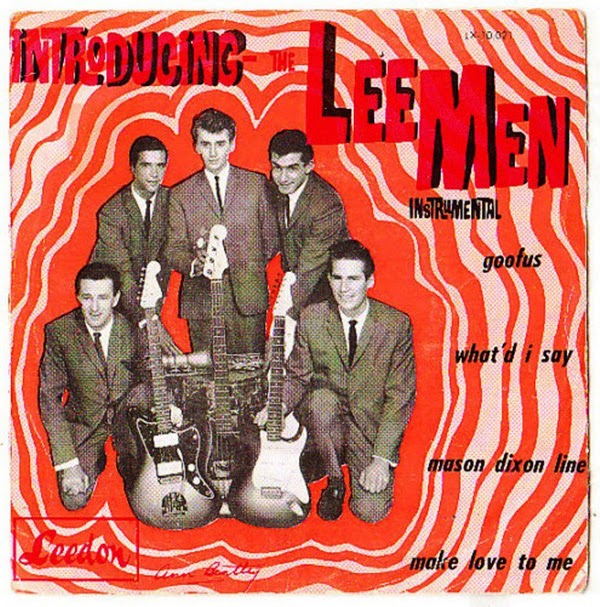
Leemen - Introducing The Leemen
What'd I Say/Make Love To Me/Goofus/Mason-Dixon Line
The Leemen are Lonnie Lee's backing band and have been there with him since the beginng and are still there today.
The Leemen had a hit in 1960 with Johnny Guitar it charted in most of Australia's capital cities #5 Sydney, #34 Melbourne, #18 Brisbane, #9 Adelaide and #16 Perth. They released a second single in 1961 "High Noon/Gumbo" plus two EP's "The Leeman With Voices" and "Introducing The Leemen" both released in 1961.
Subscribe to:
Posts (Atom)