Translate

Saturday, 16 January 2016

Merv Benton - 1966 - More Merv Benton


Feel  It/You Got What It Takes/The Worryin' Kind/I'll Go Crazy


 The Merv Benton story is a fascinating chapter of the Beat Boom in Australia. From his base on the Melbourne dance circuit, Merv gained national attention and quickly became one of the most popular male singers in the country. In early 1964 he signed with Melbourne's W&G Records and became one of their most prolific artists, releasing seventeen singles, six EPs, and three LPs between 1964 and 1967, and scoring an impressive run of fifteen Top 40 singles in his hometown (several of which also charted in other cities). But in 1967, at the height of his popularity, Merv was struck down by throat problems that ended his singing career.

Merv (real name Mervyn Bonson. b. 12 August 1942) grew up in the Melbourne suburb of Reservoir and went to school at Preston High, where he was an enthusiastic tennis player. After he left shool he joined a major Victorian bank as a trainee but as a teenager he listened avidly to rock'n'roll on Melbourne radio and was captivated by the music of Elvis Presley, Sam Cooke, Gene Vincent, Chuck Berry, Little Richard and Jerry Lee Lewis. Merv saw his first Lee Gordon 'Big Show' in 1957, which featured Bill Haley & The Comets, The Platters and Freddie Bell and it was Bell especially who fired Merv's desire to become a singer.

His entry into showbiz was a classic tale, not dissimilar to that of American comedy star Adam Sandler. He started to attend dances at which pioneering Melbourne rock'n'roll band The Planets were the headliners, and he became friends with several of the group, especially the pianist Graeme Howie. Unbeknownst to Merv, Graeme entered him in a talent contest at the local Canterbury Ballroom in October 1960. By the time his name was called it was too late to back out, but as it turned out his very first public performance -- singing "Don't Leave Me This Way" -- won him first place. The same night he met young promoter Brian de Courcy.

 A week later Merv met with De Courcy and decided to tfollow his dream of becoming a singer. Brian installed Merv as the vocalist with The Ramrods, a group led by Ian B. Allen and he was soon performing with them at venues like Whittlesea Hall and the Preston Migrant Centre. He quickly built up a strong local following -- creating what historian Noel McGrath charmingly describes as "mild hysteria" -- and even before his first record release he had his own fan club, with over 250 members -- a remarkable feat considering his only exposure at this stage was at local dances in Melbourne.

Early in 1964 Merv was invited to make some demo recordings for the W&G label. The session was produced by Johnny Chester and the backing was provided by Les Stacpool (guitar), Albert Stacpool (keyboards), Frank McMahhon (bass) and Mick Lynch (drums); also in the studio was the renowned Stan Rofe, who helped advised and encouraged many Australian acts including Merv.

W&G were happy enough with the demo to select two tracks from it for Merv's debut single -- a version of Elvis Presley's "Baby, Let's Play House", backed by "Endless Sleep", which was the first in a string of Top 40 singles, reaching # 17 on the Melbourne charts, which in turn led to TV appearances on Graham Kennedy's In Melbourne Tonight.

He was soon back in the studio to cut his next single; the original choice was Carl Perkins' "Honey Don't" but this was abandoned after The Beatles' version was released. a version of the Eddie Cochran classic "Nervous Breakdown" (b/w "Don' Cha Think It's Time") -- this time backed up by W&G's brilliant 'house' band, The Strangers -- but amid the hullaballoo of The Beatles tour was largely ignored and only reached #40 on the Melbourne charts, although Merv says that it was one of his most requested numbers.

Merv's look has been described as being in contrast to the new wave of long-haired, Liverpool-sound groups of the era but this is something of a misnomer. Films and photos of the period wll reveal that Merv's style was actually fairly typical of the time -- take a look at an old Aztecs clip, for example -- and with his clean-cut image and matinee-idol good looks, immaculately coiffed hair and sharply tailored clothes he undoubtedly won the hearts of young fans all over Australia.

Merv's next single, "Be Sweet" b/w "You're The Dog" (Aug. 1964) was issued as a reaction to criticism the W&G label was getting from radio. W&G's two-trackstudio was fairly primitive, even by the standards of the day, and some Melbourne DJs were critical of the poor sound on W&G recordings. This became a perennial problem for Australian artists and led to the long-standing practice of taking major releases to the USA to be mastered, due to Australia's relative lack of expertise in that area. Both songs on this sngle were covers of German pop songs which W&G had sourced through its publishing connections. The instrumental tracks were completely recorded in Germany, with Merv's vocals overdubbed vocals over the top. It helped to restore Merv's chart fortunes, reaching # 22 in Mebourne.


 Merv's first year as a pop star was frantic -- in just nine months he had released four singles, one EP and one LP By the end of '64, the 19-year-old singer had appeared on appeared on national television shows such as Brian Henderson's Bandstand and Johnny O'Keefe's Sing Sing Sing, and W&G released his debut album, Come On And Get Me, by which time he had become a regular on national and local TV pop shows; and had toured the country supporting Merseybeat star Billy J. Kramer.


Merv's career peaked during 1965, thanks to a continued run of successful singles. "I Got Burned" / "Cincinatti Fireball" (May) became a double-sided hit and proved to be his most successful 45 -- the A-side reached #3 in Melbourne, and the B-side was Top 5 in both Brisbane and Adelaide. His cover of Bobby "Blue" Bland's "Yield Not To Temptation" (August) reached #6 in Melbourne and also made the Adelaide Top 40. Merv's version of Crahs Craddock's "Don't Destroy Me" (October) was a Top 20 hit in Melbourne, and is also notable as one of the very first Australian pop singles to be released in a picture sleeve. Merv recalls that Noel Watson's "Can I Believe It's True" was always intended as the A-side and that he was disappointed when radio picked up "Don't Destroy Me" instead.

His next single "(I Do) The Shimmy Shimmy '65" (Dec. 1965) was evidently a filler track, issued by W&G to maintain Merv's release schedule. It was in fact a 'very simple remix' of the B-side of "Come On And Get Me"; the only difference was an additional backing vocal by Noel Watson, and Merv recalled: "No-one was more surprised than I when I heard it on the radio."

Throughout the year he toured around Australia with his new backing group, The Tamlas. The original lineup was Charlie Gauld (guitar, ex-Thunderbirds), Ian B. Allen (bass, ex-Planets), and Eddie Chappell (drums, ex-Checkmates), but for most of their career The Tamlas comprised Chappell, the legendary Les Stacpool (guitar, ex-Chessmen), Noel Watson (guitar) and Dennis Tucker (bass, ex-Rondells). The lineup that backed Merv on most of his recordings was Les Stacpool and Noel Watson (guitars), Murray Robertson (keyboards), Dennis Tucker (bass) and Eddie Chappell (drums), with backing vocals on most of the singles by the trio of Pat Carroll, Anne Hawker and Julie McKenna.

 Merv was evidently widely popular -- on her Brisbane In The Sixties site, Queensland rock fan Di Bingham cites Merv as one of her favourite Aussie performers of the period. He released four more singles in 1966 and, says McGrath, "created great excitement amongst female fans wherever he sang". He continued into 1966 "on the crest of a wave" with his winning formula of re-recordings of rock'n'roll standards. However it was at this time that he gradually began to be troubled by a nagging throat problem.

 By August 1966 his throat condition had become so serious that he was forced to withdraw from a major concert at Melbourne's Myer Music Bowl. Later that month it was announced that he was suffering from a paralysed larynx, and that he would be out of action for two years. However Merv himself has since revealed that this story was not true -- he was in fact suffering from the growth of polyps on his vocal cords, the same problem that threatened Elton John's career in the 1980s. The condition necessitated surgery, but this was years before the precise laser techniques of today, and unfortunately Merv's vocal cords were lacerated during the operation. The result was that he was not even able to speak, let alone sing, and he faced a long recuperation.

Merv: "By the time my throat had healed some six to eight months later, there was no interest (except for a few loyal fans) in the career of Merv Benton. Due to the lack of positive interest, I made the decision that it was time to bow out gracefully as one could; it was time for the dream to end. For those few short years that I lived what I had dreamt. I thank all the fans and all those that supported and contributed to allow me to realise that which occurred."

W&G had some unreleased material stockpiled, and Merv was able to make a few TV appearances, miming his last few singles on television. One of his last public appearances was on The Go!! Show, and it is all the more poignant seeing it now, knowing that the hopeful predictions of his return would come to naught. Unfortunately for Merv, the temporary retirement became permanent. It was a indeed tragedy for the young singer who had only recently been voted Australia's third top male vocalist, after Normie Rowe and Ronnie Burns, in the inaugural Go-Set Pop Poll.


 With the end of his show business career, Merv returned to work with the State Savings Bank of Victoria in their public relations department. However he began to feel stifled and frustrated with bureaucracy, so, he relocated to Queensland in 1969 and set up his own real estate development business.

However, Merv did make some final recordings for W&G after recovering from his throat problems. Accompanied by Melbourne group The Fendermen, he returned to the studio in 1970 to cut a number of country tunes that were released on the album Great Country Songs (Movin' On). This is a now something of a rarity, but several tracks were included on the Canetoad CD compilation Great Shakin' Fever.

In the early 1980s Merv returned to the recording studio after he was approached by his old fried Ian B. Allen to perform again in Melbourne. Merv agreed when he found out that the backing band, The Allstars, included Les Stacpool on guitar, the legendary Henri Bource on sax and Murray Robertson on keyboards (both ex Thunderbirds), Ron Chapman on drums and Ian on bass. This group recorded a 5-track EP, with Merv singing on three of the cuts.

In 1991, Merv migrated to the USA and became a consultant and manager for the American Child Care Centres chain. However he has made occasional live musical appearances and in the early 2000s he he has returned to Melbourne from his new home near Phoenix, Arizona Australia to perform at an annual Sixties concert.

Campact and The Dream - 1968 - Something Easy-Mercy Mercy Mercy


Campact
 Something Easy/Michael
The Dream
Who Could Be Lovin' You/Mercy Mercy Mercy


Cam-Pact were formed in Melbourne in April 1967 with a line up of Mark Barnes on bass guitar (ex-Moppa Blues, Roadrunners, Delta Set); Keith Glass on vocals and guitar (Rising Sons, Eighteenth Century Quartet); John Pugh on guitar, vocals and autoharp (Roadrunners, Delta Set, Eighteenth Century Quartet); Chris Stockley on guitar (Roadrunners, Delta Set); and Bob Lloyd (aka Bob Tregilgus) on drums. Originally named The Camp Act but, as that was "too outrageous", they soon changed to Cam-Pact. Initially they performed soul music in the Stax Records and Tamla-Motown mould. By 1968 Greg Cook, on organ and guitar, had replaced Pugh; and Trevor Courtney had replaced Lloyd on drums.

In March 1968 they issued their debut single, "Something Easy", on Festival Records followed by a four-track extended play of the same name. The track was written by Glass. Their second single, "Drawing Room", appeared in May and was also written by Glass. It was followed by a third single, "Good Good Feelin'", in September, which was co-written by Cook and Courtney. Late that year Barnes left and Glass took up bass guitar. The group issued a fourth single, "Potion of Love", in June 1969. Australian musicologist, Ian McFarlane, described these singles as "fine examples of late 1960s psychedelic pop".


 A balcony in Carlton, Melbourne (circa 1967)
Left to right - Mark Barnes, Chris Stockley
 Keith Glass, John Pugh & Robert Lloyd


By mid-1969 Glass had left to join the cast of Hair and Stockley left to join Axiom, and they were replaced by Chris Löfvén on bass guitar and Russell Smith on guitar, respectively. The group issued a second EP, Cam-Pact / Pastoral Symphony, with two tracks by Cam-Pact and two by label mates, Pastoral Symphony, which were a studio ensemble. Soon after Cook was replaced in Cam-Pact by Bill Blissett on organ and vocals. In September that year they released another single, "Zoom Zoom Zoom", and an EP of that name.


Outside The Stokehouse at a beach stomp
L to R: Trevor Courtney, Keith Glass, Chris Stockley & Greg Cook


Early in 1970 Ray Arnott (ex-Chelsea Set, Browns) replaced Courtney on drums and Cliff Edwards replaced Löfvén on bass guitar. They toured to Sydney with Matt Taylor guesting on lead vocals (ex-Wild Cherries). A three-piece line up of Arnott, Edwards and Smith continued until March 1970 before the trio formed Company Caine with Gulliver Smith on lead vocals and Jeremy Noone on saxophone.


  The Dream formed in 1967 when singer Alex Opitz and keyboard player Jenny Johnson, both from The Changing Times, joined forces with members of another Melbourne discotheque band, The Final Four. In January 1968 they appeared as a support on the infamous Who-Small Faces "Big Show" tour, and in June Peter Nicoll left the group, to be replaced by Brian Holloway. Holloway left later in the year to join the remaining members of Somebody's Image, which became The Image after the departure of lead singer Russell Morris, and he subsequently played in Ronnie Charles' shortlived supergroup Captain Australia & The Honky Tonk.

 The Dream did not make any known commercial recordings. In April 1969 the group was relaunched as The New Dream, and their style changed to exploit the current "bubblegum pop" trend; Glenn A Baker has written that their agency was grooming the band to take over from Zoot. They signed with Festival and issued their first two singles during the year, "Yours Until Tomorrow" (April) and Catching Up On Fun" (July), which made the Melbourne charts.


Their first national success came with their third single, "Groupie", one of a string of successful formula bubblegum songs written by Buzz Cason, the American who also penned "Hayride" (the hit debut for The Flying Circus) and "Everlasting Love", which was also a big hit for The Town Criers. "Groupie" became a national hit, reaching #28 in March 1970, but the time the single came out the lineup had changed to Kadell, Johnson, John Bois (bass) and Peter Reed (drums).

 Regular dance circuit bookings and TV appearances on Happenning '70 helped the band to build up popularity with teen audiences, and their next three singles all made the charts. "Soft Delights" (May 1971) only just missed out on a Top 20 placing, and although "Candy Love" (Sep. 1971) only scraped into the lower reaches of the Top 100, "Turned 21" (March 1972) fared much better, reaching #31. In January 1972 John Bois left to join Country Radio and he was replaced by Graham Jones (also ex Iguana,  Captain Australia & The Honky Tonk).

 This new lineup recorded their only LP and their last two singles, a cover of T-Rex's "Ride A White Swan" (Dec. 1972) and "Girl I'm Gonna Get You" (Feb. 1973). Their self-titled LP, produced by Brian Cadd, featured what Ian McFarlane describes as "...a gloriously campy mix of the band's bubblegum hits, easy listening pop fluff replete with sweet harmonies and schmaltz strings, plus a cover of joni Mitchell's 'Cheslea Morning' ...".

The group broke up at the end of 1972; with Kadell embarked on a solo career, and Peter Reed joined Gary Young's Hot Dog (he later played with Pantha and Bandicoot, the group that featured Mick Fettes (Madder Lake) and Shane Bourne). Kadell and Johnson revived the New Dream name for two singles released during 1974. The first, "I Can't Stop Dancing (In The Dark)" (July) was written by Andy Fairweather-Low and produced by Steve Groves (ex Tin Tin); the second the oddly-titled "Schlick Schlak Boom Boom" was produced by Buddy England. Neither single made any impression, and the group faded from view.

Friday, 15 January 2016

Red Onions Jazz Band - 1964 - Red Onions At Home


Oriental Man/The Onions/Farewell Blues/Gatemouth Stomp


The Red Onion Jazz Band (c. 1960–2008) was a trad jazz band formed in Melbourne (Australia) in the early 1960s and was also known as "The Red Onions” and "The Onions".

The Red Onion Jazz Band was formed around 1960, as the Gin Bottle Jazz Band, by Allan Browne who was taking lessons from Melbourne University Jazz Band's drummer, Norm Hodges, and Brett Iggulden who was taking trumpet lessons from Ade Monsbourgh, then one of Australia's leading jazzmen. The original lineup, drawn largely from the bayside Beaumaris, Sandringham and Brighton suburbs of Melbourne, consisted of Allan Browne, drums; Brett Iggulden, trumpet; Kim Lynch, tea-chest bass; Bill Howard trombone; Felix Blatt, banjo and John Pike, piano, while Brett’s sister Sally (aka "Sweet Sal", who later married Browne and became a clothes designer) was an occasional addition on washboard. John Funsten, another pupil of Ade Monsbourgh, was added on clarinet. They played New Orleans inspired traditional jazz and infused it with their own vitality, their flair for presentation and promotion and zany sense of humour.

Jazz standards were the material for their first job at St Michael & All Angels Anglican Church hall dance in Beaumaris, and by about April 1961, they were given a brief spot at the Melbourne Jazz Club; their first introduction into the Melbourne jazz scene and in June Corrine Kirby included them on her ABC T.V. programme Let's Make a Date for which, at the insistence of Channel 2 executives a name change from their original Gin Bottle Jazz Band to the more respectable Red Onion Jazz Band was made, the title chosen in honour of an early Louis Armstrong recording group. They opened then at the 'Oxford' Jazz Club, where they continued for six months, with Fred Charles on clarinet.

In November 1961, Geoff Thomas took over from Felix Blatt as banjoist and the band started the Red Onion Jazz Club in Brighton. They also played at the Downbeat Jazz Concert in 1962 before Fred Charles and Geoff Thomas left the band in October and were replaced by Gerry Humphries (born Brian Anton Humphrys, 1941, in Battersea, England) and Rainer Breit. After securing gigs at the Ormond R.S.L. Hall and Beaumaris Yacht Club, they joined the 17th Jazz Convention in Sydney in December 1962, where their long hair, formal wear, violins and mad vocals caused a stir. Returning to Melbourne they played Friday nights at the 'Newport' Jazz Club at the Edithvale Life saving Club and on Saturday nights at their own venue ‘The Onion Patch' in Oakleigh. In early 1963, the group released their first 7” EP, An Impromptu Recital by the Amazing and Entertaining Red Onion Jazz Band on the tiny EAST (Elwood Audio Services Transcriptions) recording label, and it received conspicuous airplay on radio station 3XYs Jazz As You Like It program. John Pike left in March and for 11 months the band played without a pianist, but had a busy year of concerts that included Moomba, Myer Music Bowl, a 3-day tour of Tasmania including radio, T.V. and dance engagements in Hobart, as well as the 18th Australian Jazz Convention. The Red Onion Jazz Band at the 1963 Jazz Convention EP (their second recording) contains two vocal tracks; the bawdy sea-shanty "Barnacle Bill", and a version of Tommy Dorsey's "It’s Tight Like That". Gerry Humphrys left the band for four months in June 1963, and Jerry Salt, Derek Miller or Eddie Robbins replaced his clarinet, while Brett Iggulden took up alto sax for special numbers. Venues then included the 'Driftwood' Club and the 'Downbeat' Jazz Club where in February 17-year-old pianist Ian Clyne first sat in and thereafter became a regular member.

In July 1964, The Red Onions signed with W&G Records who put out a well-received EP entitled The Red Onions At Home and they transferred from the 'Onion Patch' to the popular 'Campus' Club. They appeared again on TV for GTV9 and ATV0, most importantly on Graham Kennedy’s influential In Melbourne Tonight. In November the band opened at ‘Opus' discotheque in South Yarra where it was estimated that more than 2,000 attended the first night. The entire band also featured at the 19th Jazz Convention in Newcastle.

In early 1965, The Red Onion Jazz Band released their self-titled debut LP. Its black-and-white cover art was designed by tuba player Kim Lynch, however in October, he and two other members, clarinetist, vocalist and occasional violinist Gerry Humphreys and Ian Clyne left, after three years of success, to play together the electric Rhythm and Blues that was beginning to eclipse jazz amongst younger audiences, especially after the visit of the Beatles to Melbourne in 1964. Humphrys and Lynch went on to form The Loved Ones.

After this split The Onions’ Brett Iggulden (trumpet and vocals), Bill Howard (trombone and vocals) and drummer Allan Browne persevered, joined by John Scurry (banjo and guitar) and Richard Miller (clarinet) in 1965. In 1967 the group left Australia for a 10-month, 50,000-mile tour of Europe. During the tour the band performed at the Jazz Jamboree in Warsaw, Poland, during October 1967, and at jazz clubs, ball rooms, jazz festivals and on radio. On return to Australia they continued to appear on television, at balls and discothèques, jazz clubs, university concerts and fashion parades.

Between 1974 and 1983 the Onions did not perform together. In 1983 they reunited in a benefit for Bill Howard who had lost his house and possessions in the Ash Wednesday bushfires. Thereafter they performed quite regularly, with festival appearances and occasional gigs in Melbourne. They travelled to Europe a third time in 1992, and released the CD Crisis shortly thereafter.

With Bill Howard’s death from cancer in 1996 the Red Onions finally disbanded, with their last formal appearance at the Wangaratta Festival of Jazz and Blues. At this performance they featured their mentor and long time friend, Ade Monsbourgh.


Members
•Allan Browne - drums (1961-
•Brett Iggulden - vocals, trumpet, alto saxophone (1961-
•Kim Lynch - tea-chest bass, tuba (1961–65)
•Bill Howard - trombone, vocals (1961-
•Felix Blatt - banjo (1961)
•John Pike - piano (1961–63)
•Sally Iggulden - washboard (1961-?)
•John Funsten - clarinet (1961)
•Conrad Joyce - bass (1969-
•Fred Charles - clarinet (1961–62)
•Geoff Thomas - banjo (1961–62)
•Bill Morris - tuba (1965-1969)
•Gerry Humphrys - vocals, clarinet (1962–63, 1963–65)
•Rainer Breit - banjo (1962-?)
•Jerry Salt - clarinet (1963)
•Derek Miller - clarinet (1963)
•Eddie Robbins - clarinet (1963)
•Ian Clyne - piano (1964–65)
•John Scurry - banjo, guitar (1965-
•Richard Miller - clarinet (1965-

Thursday, 14 January 2016

The Cherokees - The Cherokees


That's If You Want Me To/The Angels Listened In/Only If You Care/I Can Tell


Named after a popular ice cream of the time, the Cherokees were formed in 1961 when Johnny Chester suggested to Billy Dale the guitarist in his backing band the Chessmen that he should form his own band as the Chessmen were getting to big as sometimes the band included 3 guitarists so Billy left forminfg the Cherokees and began playing Shadows-styled music around Melbourne, Australia.

 Signing with W&G Records, the Cherokees released two singles and the rare Here Come the Cherokees album in 1965. They began playing pop reminiscent of the Beatles and moved to the short-lived Go! label. Several of their singles made the Top 40 in Melbourne. By 1967, the Cherokees were playing swing-styled music and several more singles again made the Melbourne Top 40. An album followed, Oh Monah!, but with the collapse of Go!, the band was left without a deal. Despite releasing one more single on Festival records and supporting the Monkees during their tour of Australia in October 1968, the Cherokees broke up at the end of the year.


The first line was

Billy Dale - guitar
Alan Chung - rhythm guitar
Mick Lynch - drums
David Thompson - Bass

Later Barrie Windley came in on drums plus Barrie King on rhythm guitar and vocals. Barrie King left the band and was replaced by Lindsay Morrison on rhythm guitar. With this line-up they recorded the instrumental album "Here Come The Cherokees".

Doug Trevor went from bass to lead guitar with Pete Tindale formally from "The Scorpions" replacing Doug. The band was playing at a venue called "Tenth Avenue" during lunch times, a venue many must remember. "The Cherokees" went into the studio and recorded "I've got something to tell you baby" on W@G records B/W Hubble Bubble. This was around the time of GO! records became known. They recorded many singles at that time.

Around this time the group toured Sydney, Brisbane, Melbourne, Adelaide, Perth, and Tasmania. By the time of the "THE MONKEES" tour 1968. Around this time guitarist Mike Macquire, a former member of Adelaide's "Harts" joined.

The band were probably at their best with the hit "Minnie The Moocher" with singer Kevin Smith.

Other members included.

Pete Tindal - guitar
Kevin Smith - vocals
Barrie Windley - Drums
Billy Dale - Lead Guitar
Doug Trevor - Bass
Lindsay Morrison - Rhythm Guitar
Mike McQuire - lead guitar

Bobbie & Laurie - I Belong WithYou


 I Belong To You/The Glory Of Love/Hold Me/Goodnight Irene


 Bobby & Laurie were a popular Australian singing duo of the 1960s, featuring Laurie Allen (vocals, guitar, keyboards) and Bobby Bright (vocals, guitar). Their regular backing band were The Rondells. The pair formed one of the leading acts in the first wave of the Australian 'beat pop' era between 1964 and 1967, alongside contemporaries such as Billy Thorpe & The Aztecs, Ray Brown & The Whispers, The Easybeats and Normie Rowe. They became one of the most popular and successful acts of their day.

Allen's first amateur group was in Melbourne in the late 1950s and called The Three Jays. This was followed by The Lories (c.1958) and The Roulettes (1958–59), a long-running Melbourne revue band. From 1959 to 1961, he was lead guitarist for Malcolm Arthur & The Knights and in 1962 was lead singer/organist of a previously instrumental group The Blue Jays. At about the end of 1963, The Blue Jays became The Fabulous Blue Jays, the backing band for singer Tony Worsley. Laurie then rejoined The Roulettes.

Bright had previously worked mainly as a solo artist, starting his singing in Adelaide. He later moved to Melbourne and released two solo singles on the W&G Records label in 1963.

One of The Roulettes was Ron Blackmore who decided to leave the performance side of the industry and move into band management. In about 1963, Allen also left the band and he and Bright performed separately as soloists under Blackmore's management in the dance club circuit around Melbourne. On 11 March 1964, Allen made his first solo television appearance, on Graham Kennedy's In Melbourne Tonight. Later in 1964, the two appeared on The Go!! Show and soon teamed up to create a highly successful duo through their good looks, a clean cut image and sharp performances. Originally billed as Laurie Allen and Bobby Bright, the duo became regulars on the show alongside The Strangers and were paid 50 pounds per appearance.

They had the first record on the new Go Records label with I Belong With You #9 which was released with its 45 B-side song Trouble in Mind in August 1964. The record was produced by English producer Roger Savage, who had just arrived in Australia from London where he had worked with the Rolling Stones. I Belong With You was a hit staying at number-one on the Melbourne charts for two weeks and won Laurie an Australian Record Award for 'Best Composition' in 1965.

At this time, Bobby & Laurie started working with a Blackmore-managed backing band The Rondells (previously called The Lincolns and The Silhouettes). The duo reached their peak in late 1964, busily touring the country and appearing in numerous concert and television performances. They had dozens of engagements and personal appearances every week, with as many as six shows on a Saturday night. One unusual performance was playing 'Tweedledum' and 'Tweedledee' in a Christmas pantomime production of Alice In Wonderland at the Tivoli Theatre in Melbourne in December 1964.

In early 1965 the pair appeared on the Teen Scene music television show on the ABC, where they were famously dragged off the stage by screaming female fans. They appeared in the premiere episode of Channel 0's new children's program the Magic Circle Club on 23 January, playing characters 'Twoddle' and 'Boddle'.

They released three more successful singles on the Go label during 1965: Someone (which reached #3 in Melbourne), Judy Green and Crazy Country Hop which reached #25.

In May 1965 they supported a national tour by The Dave Clark Five, The Seekers and Tommy Quickly. Later in the year they supported American P. J. Proby on his national tour.

In 1966 they switched to the Albert Productions label, releasing Sweet And Tender Romance and Hitch Hiker, which gave them a national number-one hit for five weeks in May and June. At about this time they also changed management from Blackmore to Mal Fisher. On the strength of Hitch Hiker, the ABC gave them their own television show, It's A Gas, which was later rebadged as Dig We Must. The name change was designed to attract a more sophisticated 'adult' market, but lost the duo much of their 'teen' appeal which led to friction between the two singers.

After recording their last album Exposaic, the pair officially split in early 1967 after just three years as Australia's chart-topping stars.


Chicks - The Chicks


The Birds And The Bees/I Want You To Be My Boy/The Hucklebuck/Looking For The Right Guy


The Chicks were sisters Judy and Sue Donaldson. Both girls were born in Wellington in 1950 and 1952 respectively. They moved to Auckland at an early age and were brought up on a farm in the Huapai district.  They got their first taste of success at a talent quest in Napier one Christmas when they were still children singing as the Dots. A neighbour on the farm was Kevin Borich (later with the La De Da's) and with him they made a couple of acetates at Ascot Studios.

Their lucky break came after the family moved to Henderson, when another neighbour was entertaining, and one of his guests was Peter Posa and his manager Ron Dalton. After hearing them sing, Ron thought the girls had some potential and a few weeks later he invited them into the Viking Studio to make their first real recording, "Heart Of Stone"/"I Want You To Be My Boy". The session players on that gig were among the best in Auckland, the Mike Perjanik Band. It was Mike who gave them their name, the Chicks, and the record was released on Viking in 1965.

Because they hadn't performed in public, Dalton organised a spot for them at a teenage dance in Dargaville, to test public reaction. They also had a spot on the TV show "On The Beat Side", where they sang their second single "Hucklebuck", which was released with "Looking For The Right Guy" on the reverse in 1965.

In August 1965, the were support act on a tour featuring Sandi Shaw, the Pretty Things and Eden Kane. Following that there was another tour with Tommy Adderley and Dinah Lee.

Two more singles were released in 1965, "Do You Want To Dance" with Peter Posa, coupled with "Terry" and "Java Jones"/"He's My Guy". It was time to release their first album and this was called "The Sound Of The Chicks".   

1966 saw the Chicks appearing on TV in "A Swinging Safari" and more tours with the likes of P J Proby. Another single for Viking "Cumala Be Stay"/"Be Bop A Lula" and then one single on Impact "Tweedle Dee"/"Rebel Kind". In 1967 a visit to Australia gave them guest spots on TV shows over there. Two singles were recorded on Festival "You Won't Forget Me"/"Gotta See My Baby Every Day" and "What Am I Doing Here With You"/"River Deep Mountain High" in 1967 and 1968 before the girls joined the team on TV's "C'Mon". This show ran for 26 weeks, thereby cutting out much of their live work because of its heavy schedule.    

Three singles for Polydor were released during 1969, "Say A Prayer For Michael"/"Society's Child", "Miss You Baby"/"Are You Sure" and "Stoney End"/"Get Ready-Uptight". They also signed to a new manager that year and he tried to steer them into the more sophisticated adult-orientated cabaret scene. This was not successful and in 1970 they split up while under the management of  Ray Columbus, with their last single being "I Will See You There"/"Long Time Comin'".

During their time 1965 to 1970, they also had 3 EP's and 6 albums released. After the breakup  Judy married Ross Hindman from the Rumour and settled down to raise a family, not before recording one solo single on Philips called "Heaven Is The Place"/"I Can Hear The Picture" in 1970 and  Sue went solo under the name Suzanne.


Bobby and Laurie - Hitch Hiker


Sweet And Tender Romance/Down In The Valley/You'll Come 'Round/Hitch Hiker


 Hitch-hiker released in 1966 was #1 Sydney #1 Melbourne #1 Brisbane #1 Adelaide #1 Perth #4 NZ .

Melbourne's Bobby Bright and Laurie Allen had a number of pop hits in the mid-60s, from the danceable Laurie Allen composition I Belong With You (1965) to the country style Hitch-hiker. They were regulars on the Go!! TV pop show and later had their own show on ABC-TV (Australia), It's A Gas, later Dig We Must.

Bobby & Laurie broke up in 1967 but their 1969 reunion produced two further hits, The Carroll County Accident (1969) and Through The Eyes Of Love (1970).

Later, Laurie Allen moved into country music, and Bobby Bright, who had been a disc jockey with Melbourne radio station 3XY, also acted on TV and film (his career is summarised, incompletely, at the Internet Movie DataBase).

Double-sided hit in Brisbane with You'll Come Around.


Booka Hyland - Booka At The Police Boy's Club


Sweet Thing/We've Got Something Going/The Right Time/Transistor


Booka Hyland (b. John, c.1940) was an established pub singer when he was heard by Warren Williams and his band who urged him to contact Johnny O'Keefe. He ended up as a regular on O'Keefe's TV show Six O'Clock Rock and joined O'Keefe on tour.

 John Hyland began his career in 1956, entering talent quests in local pubs. Six years later he became lead singer for the Leedons who of course the became Booka Hyland and The Leedons. Then 4 years as lead singer for The Chessmen.

Hyland released a handful of singles, only one of which charted, the John Marascalco-Scott Turnbull song Sweet Thing (1960, #33 Sydney). His second single, We've Got Something Going (1960) was another John Marascalco composition. He also released a four-track EP, Booka At The Police Boys Club, featuring the three A-sides plus a B-side. See also I Dig Girls, the B-side of Sweet Thing.

At this time O'Keefe was an active A&R man and producer for the Lee Gordon and Leedon labels. He often used the name Eddie Cash Jr because, as he put it, I think the disc jockeys got a bit sick and tired of hearing my name all the time [quoted in The Wild One, see below]. The "Eddie Cash" vocalists and musicians covered a studio roster that included many well-known Sydney performers.

"Booka" was a childhood nickname. Until his first record showed his surname, Johnny O'Keefe had billed him simply as Booka.

Sunday, 3 January 2016

Johnny Farnham - Number One


One/Underneath The Arches/Rose Coloured Glasses/Jamie


"One" is a song written by Harry Nilsson and made famous by Three Dog Night whose cover in 1969 reached number 5 on the Billboard chart. The song is known for its opening line "One is the loneliest number that you'll ever do." It appeared initially on Aerial Ballet (1968), Nilsson's third album. Nilsson wrote the song after calling someone and getting a busy signal. He stayed on the line listening to the "beep, beep, beep, beep..." tone, writing the song. The busy signal became the opening notes of the song.

In 1968, Al Kooper released the song on his debut album I Stand Alone. In 1969, the rock band Three Dog Night covered the song on their debut album Three Dog Night, with Chuck Negron on lead vocal. The song was released as a single and became a hit, reaching number 5 on the Billboard Hot 100. That same year it was covered by Australian pop singer Johnny Farnham, reaching number 4 on the Go Set National Top 40 Chart.

"Underneath the Arches" is a 1932 popular song with words and music by Bud Flanagan, and additional lyrics by Reg Connelly. It was one of the most famous songs of the duo Flanagan and Allen.
In 1968 Australian pop singer, Johnny Farnham, covered the track, as his second single, which reached No. 6 on the Go Set National Top 40 Singles Chart.

"Jamie" is a song written by singer songwriter Hans Poulsen and released by Johnny Farnham in 1968 reaching No. 8 on the Go Set Charts.

"Rose Coloured Glasses" was also written by Hans Poulsen and released by Johnny in 1968 and climbed to No. 16 on the Go Set charts

Friday, 1 January 2016

Billy Thorpe - 1965 - Stand By Me


Stand By Me/Half As Much/My Babe/High Heel Sneakers


Three tracks taken from their second album "Billy Thorpe And The Aztecs" released in 1965 while the 3rd track My Babe only appeared on this EP.


Thursday, 31 December 2015

Johnny O'Keefe - Move Baby Move


Move Baby Move/You'll Never Cherish A Love So True/Ooh Poo Pah Doo (Parts 1 & 2)


Single on Leedon by Johnny O'Keefe (1935-1978), Australia's biggest star of the rock'n'roll era, known as The Wild One, The King of Rock'n'Roll or just J. O'K.

Move Baby Move was released in 1963 and shot to #1 Sydney #1 Melbourne #7 Brisbane #1 Adelaide #1 Perth. Single on Leedon by Johnny O'Keefe (1935-1978), Australia's biggest star of the rock'n'roll era, known as The Wild One, The King of Rock'n'Roll or just J. O'K. In Adelaide and Sydney, this was a double-sided hit with the  B-side, You'll Never Cherish A Love So True (Until You Lose It).


Ooh Poo Pah Doo was also on two other EPs, Six O'Clock Rock Vol. 2. 91960) and Ooh Poo Pah Doo (1964), the song was a favourite live item for JO'K, especially on his TV shows.

Wednesday, 30 December 2015

Ram Jam Big Band - 1968 - Ram Jam Big Band


Sunshine And I Feel Fine/Rainy Sunday/My Girl/I Didn't Know


 Moderately successful Australian '60s pop band which featured brass in the lineup
.
Although membership changes were frequent, the RJBB were a breeding ground for many other respected musos, the best known members being drummer Gary Young (Bobby & Laurie's Rondells,Daddy Cool, Jo Jo Jo Zep & solo artist), his long time partner in rhythm, bassist Wayne Duncan (also Rondells/DC/Black Sorrows/Gary's Rocking Emus), keyboardist Ian Clyne (The Loved Ones, Chain), original drummer Ray Evans who became a long time manager for Renee & Russell Morris among others,sax player Michael Edwards (Pink Finks/Party Machine/Gerry & The Joy Boys, as well as acclaimed jazz players like Don Wright (SCRA) & John Ellis (Kush)


They released four singles "Sunshine And I Feel Fine", a Top 10 hit in their hometown. The Temptations "My Girl" which just missed the Top 20 but sold consistently well to hang around for 3 months. A 3rd Top 30 hit soon followed in the superb soul ballad "I Can't Let Go of This Feeling", which contains one of singer/trumpeter Russell Smith's best vocals on record. Unfortunately a final single "Lost & Found" failed to connect & the band broke up after 3 years in 1969.

Purple Hearts - The Raven EP


Of Hopes & Dreams & Tombstones/You Can't Sit Down/Chicago/Tiger In Your Tank/I'm Gonna Try/Early In The Morning


The Purple Hearts were an Australian rock group, formed in Brisbane in 1964. The band consisted of lead vocalist Mick Hadley, lead guitarist Barry Lyde (known as Lobby Loyde), rhythm guitarists Paul Steffen (1964-65) and Fred Pickard (1965-66), bassist Bob Dames, and drummers Adrian 'Red' Redmond (1964–66) and Tony Cahill (1966-67).

It is notable that Brisbane, traditionally the most conservative of Australia's state capitals, has fostered some of this country's most anarchistic rock bands from The Purple Hearts to The Saints. The Purple Hearts were tough, arrogant and pioneering and Lobby Loyde is widely acknowledged as Australia’s first true rock guitar hero – busy blowing up speaker boxes before high volume and feed-back became rock staples.

Although they were part of the Sunshine Records stable (which included Australia's top male teen idol Normie Rowe) The Purple Hearts were uncompromising in their attitude toward recording. Consequently, their handful of singles are enduring artifacts of their unique style, which blended blues, R&B and prototype psychedelic rock, a style made even tougher by the regional influence mentioned earlier. Even their name, taken from the well-known slang term for a variety of amphetamine pop pills much favoured by mod subculture, was a brash and outrageous gesture.

Hadley, Dames and Pickard were, like so many of Australia’s rock stars, English migrants. Upon arrival in 1963 they joined forces with two other young R & B sympathisers – Lyde and Adrian Redmond – to form the Purple Hearts. Redmond was subsequently replaced by Tony Cahill, who was later chosen as Snowy Fleet’s replacement in The Easybeats.

Early in 1966 the group moved base to Melbourne, where they enjoyed minor chart success with "Early In The Morning". They quickly became a prominent part of the city's thriving pop scene and made several appearances on Australia's leading pop TV series The Go!! Show. A year later they exited with suave by issuing a press release stating that they had ceased to progress musically, were becoming stagnant and, therefore, had no reason to continue.


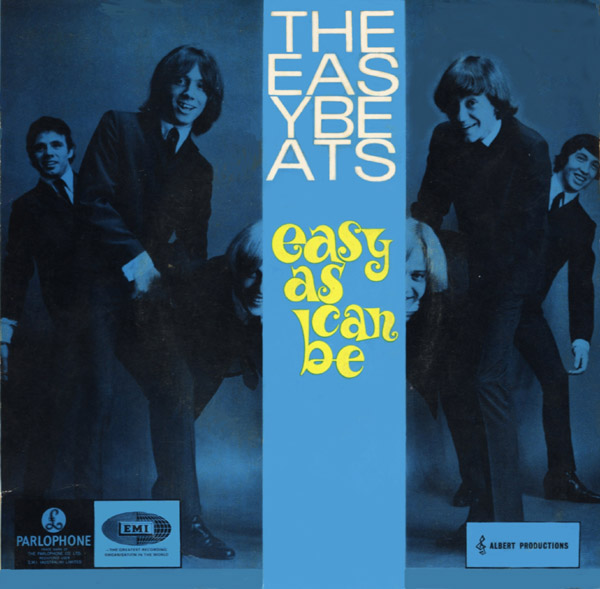
Easybeats - Easy As Can Be


Easy As Can Be/Sad and Lonely and Blue/ Me Or You/Wedding Ring


Meant to post this a few days ago as a tribute to Stevie Wright who has passed away  The ARIA hall of famer became ill on Boxing Day and was taken to Moruya Hospital on the New South Wales south coast, where he died on Sunday  night (27.12.2015) aged 68 his son Nick by his side.

RIP Stevie.

Jimmy Little - 1964 - One Road


One Road/Just A Closer Walk With Thee/Each Step Of The Way/By And By


James Oswald "Jimmy" Little, AO (1 March 1937 – 2 April 2012) was an Australian Aboriginal musician, actor and teacher from the Yorta Yorta people and was raised on the Cummeragunja Mission, New South Wales.

From 1951 he had a career as a singer-songwriter and guitarist, which spanned six decades. For many years he was the main Aboriginal star on the Australian music scene. His music was influenced by Nat King Cole and American country music artist Jim Reeves. His gospel song "Royal Telephone" (1963) sold over 75,000 copies and his most popular album, Messenger, peaked at No. 26 in 1999 on the ARIA Albums Chart.
One Road Charted at #31 on the Australian Charts.


Ray Columbus And The Invaders - Now You Shake


Now You Shake/Made You/Remember (Walking In The Sand)/Orbie Lee


Ray Columbus & the Invaders were a rock group from Christchurch, New Zealand that was active from 1964 to 1966, and fronted by leading vocalist, Ray Columbus a musician, television host and manager. Part of the new surf music craze, they were the first New Zealand band to have an international number 1 with a cover of The Senators "She's A Mod".

Influenced by the early 1960s work of Cliff Richard and The Beatles, Ray Columbus & the Invaders scored a #1 hit in Australia thus becoming the first New Zealand band to have an international #1 song[1]—and New Zealand with "She's a Mod" in 1964, a cover version of a song by The Senators. Ray Columbus and the Invaders were included in a package tour "Big Beat '65" with Roy Orbison, The Rolling Stones and The Newbeats that toured New Zealand and Australia. During the tour, the Invaders performed as Orbison's backing band as well as performing as Ray Columbus and the Invaders.

They had several more hits in New Zealand before disbanding in late 1965. Leader Ray Columbus later moved to the US where he found a California psychedelic band, Newcastle Five, who he renamed as The Art Collection. As a band, Ray Columbus and The Art Collection released four singles for the Colstar label, including the psychedelic rocker "Kick It" before The Art Collection split with Columbus. During his time in California (1966–68), Columbus was offered an audition with The Monkees but turned this down. He was also turned down the chance to get together with David Crosby or Gene Clark after these musicians left The Byrds. Columbus then went on to become a band manager.

Billy Thorpe - 1965 - I Told The Brook


Over the Rainbow/That I Love/Funny Face/I Told the Brook


Billy Thorpe and the Aztecs were an Australian pop and rock group dating from the mid-1960s. The group enjoyed success in the mid-1960s, but split in 1967. They re-emerged in the early 1970s to become one of the most popular Australian hard-rock bands of the period. Thorpe died from a heart attack in Sydney on 28 February 2007.

The band was signed by Ted Albert to his newly established Albert Productions, a local record label devoted exclusively to recording Australian pop artists. Billy Thorpe & the Aztecs had national chart success, their record sales and concert attendances rivalling those of The Beatles, with hits like "Mashed Potato", "Sick and Tired" and Wizard of Oz tune "Over the Rainbow" in the top ten of the record charts in most state capitals.

The original Aztecs lineup split from Thorpe at the beginning of 1965 over a financial dispute, so he created another set] with Johnny Dick (drums), Mike Downes (rhythm guitar, vocals), Colin Risbey (lead guitar, vocals), Jimmy Taylor (piano), Teddy Toi (bass guitar), Tony Buchanan (saxophone) and Rocky Thomas (brass). This lineup achieved further success with pop ballads such as "I Told the Brook", "Twilight Time" and "Love Letters


I Told the Brook was released in Australia in 1965 reaching #1 Sydney #3 Melbourne #1 Brisbane #1 Adelaide #2 Perth - double-sided hit in Sydney, Melbourne and Brisbane with "Funny Face".

Released in Australia 1964 reaching #1 Sydney #6 Melbourne #1 Brisbane #1 Adelaide. Over The Rainbow was on Australian charts from the end of December 1964 until June 1965. Oz Net Music Charts shows it peaking at #1 nationally for two weeks in January 1965 B-Side was  That I Love.

Monday, 28 December 2015

Max Merritt - 1964 - Good Golly Max Merritt


Good Golly Miss Molly/Everybody/Be My Baby/I Want to Hold Your Hand


The first Meteors were brought together by Max Merritt in Christchurch, New Zealand, in 1956. After becoming one of the country's top bands while based in Auckland, they moved to Australia in 1964. The Meteors went through many personnel changes along the way, before arriving at their classic late-60s line-up of Max Merritt, Bob Bertles, Stewie Speer and John 'Yuk' Harrison. Their biggest hit didn't come till 1976, with Merritt's own composition Slipping Away

A record deal was struck with Viking Records in 1964 and their first release on that label was an EP called "Giddy Up Max", containing "Giddy Up A Ding Dong", "Almost Grown", "Little Bitty Pretty One" and "Sweet and Tender Romance". A single with "Giddy Up A Ding Dong" and "Sweet and Tender Romance" also came out. The releases didn't sell very well, but the band's musicianship so impressed Viking, that the Meteors became the label's house band. They provided backing for the label's solo artists, Tommy Adderley, Dinah Lee and Peter Posa.

Viking released a second EP called "Good Golly Max Merritt", also in 1964. Its contents were "Good Golly Miss Molly", "Everybody", "Be My Baby", and "I Want To Hold Your Hand". Peter Posa did a number of live shows in 1964 and 1965, and these were captured on vinyl on two occasions. Max Merritt and the Meteors contributed one track to each of the "Live On the Peter Posa Show" albums in 1964 and 1965.


Sunday, 27 December 2015

Throb And Wild Cherries Raven EP


Wild Cherries
That's Life/Krome Plated Yabby/Gotta Stop Lying
The Throb
Fortune Teller/Black/She Is Mine


The Throb


From obscure origins as a Sydney-based surf-instrumental band, The Throb emerged in 1965 and briefly shot to national prominence. Despite its short tenure, the group left no doubt about its punkish potential and they have been immortalised on record by two superb singles, their snarling "garage-punk" version of "Fortune Teller", which smashed its way to the top of the national charts in early 1966, and their group arrangement of the old English folk song, "Black (Is The Colour Of My True Love's Hair)", a slashing, snarling piece of proto-gothic wonderment that pop culture historian Ian D. Marks calls "the most adventurous pop recording made in Australia during 1966".


 Members

 John Bell (vocals, guitar, harmonica)
 Denny Burgess (bass, vocals)
 Peter Figures (drums)
 Marty Van Wynk (lead guitar)


Singles

 March 1966
 "Fortune Teller" / "Believe In Me" (Parlophone A-8191)

July 1966
 "Black" / "Turn My Head" (Parlophone A-8212)


The Wild Cherries


 For the more radically-inclined and discerning rock aficionado of the mid-60s, there could have been few more perfect musical formations than The Wild Cherries. They sported a wild and innovative lead guitarist in Lobby Loyde, a stunning vocalist in Danny Robinson, and apart from the skills of their superb rhythm section, they displayed an onstage creative abandon to rival the mayhem of their pioneering Sydney peers The Missing Links. It was a persona that earned The Wild Cherries notoriety, respect and wide popularity in equal measures.


Singles


Jun. 1967
"Krome Plated Yabbie" / "Every Thing I Do Is Wrong" (Festival FK 1879)

Nov. 1967
"That's Life" / "Try Me" (Festival FK 2052)

Apr. 1968
"Gotta Stop Lying" / "Time Killer" (Festival FK 2258)

Sep. 1968
"I Don't Care" / "Theme For A Merry Go Round" (Festival FK 2535)

1971
"I Am The Sea" / "Daily Planet" (Havoc H 1006)


Autumn & Levi Smiths Clefs - 1970 - The Best of Whisky A Go Go


 Autumn: "Day Tripper", "Midnight Special"
 Levi Smiths Clefs: "Down in the Valley", "Lawdy Miss Clawdy" 


Autumn

Like their contemporaries The Executives, The Affair, New Dream and Zoot, Sydney band Autumn has been unfairly labelled as a lightweight pop band, mainly on the basis of their early recordings. They've also been tagged as 'one-hit wonders', although in fact they had four hits. Fronted by grievously underrated lead vocalist Tony Romeril, Autumn was a superb band with a strong following in their home city of Sydney, and they could tackle pop, country-rock and heavy/progressive rock with equal ease.

Like their close contemporaries The Flying Circus, Autumn formed at a time when rapid and significant changes were taking place in the music scene and the formerly homogeneous "pop" field was diversifying into several distinct genres. The trends that were drawing 'pop' musicians towards progressive music, "heavy rock" and country rock was counterbalanced by the popularity and commercial success of so-called "bubblegum" pop. This created to a situation where, as Glennn A. Baker has observed, being identified as a pop band "drew automatic derision and critical dismissal".

Autumn's chart success with straight-ahead pop material has obscured the fact that this was a highly competent group, with tastes and abilities which went well beyond the confines of the three-minute formula pop single. Their true talents were not really showcased on record until their last few recordings for the Warner label) and as Glennn Baker notes "... nobody, save those who caught them live, came to realise what a sturdy, musically adept and diverse unit they were."


 Levi Smiths Clefs

If there is any Australian group that deserves to be described as "influential" it's Levi Smith's Clefs. Led for most of its career by famed R&B/jazz singer Barrie "The Bear" McAskill the band was not influential in terms of its repertoire or recordings (of which there are sadly too few) but rather because of its status as one of "the 'muso's bands" of the period and as a training ground for literally scores of players and singers. Levi Smith's Clefs arguably supplied more members to more leading Australian groups of the time than any other, and the list of LSC alumni -- many of whom came from bands of great renown -- includes members of The Aztecs, Max Merritt & The Meteors, Billy Thorpe & The Aztecs, SCRA, Tully and Fraternity, to name just a few. With the possible exception of Blackfeather, few other Aussie bands had such a bewildering series of lineups, which link to literally dozens of other contemporary groups. Full credit is due to the redoubtable Chris Spencer and his colleagues, who have managed to decipher and record much of the Clefs' ever-changing membership.

Twilights - 1966 - Twilights Time


"Needle In A Haystack" / "9.50" / "What's Wrong With The Way I Live" / "Young Girl"


  The Twilights were an Australian rock and pop music group of the mid to late 1960s. Alongside their own career successes, The Twilights are also notable for the inclusion of vocalist Glenn Shorrock, who later fronted Axiom, Esperanto and Little River Band, and guitarist Terry Britten who went on to become an internationally successful songwriter and producer and pen major hits for artists such as Cliff Richard and Tina Turner.


Alongside The Easybeats and The Masters Apprentices, The Twilights are widely considered to be one of the most significant Australian rock groups of the 1960s. Highly popular with teenage audiences, they were renowned for their musical excellence and live prowess, as well as their on-stage humour, and they were held in high respect by fellow musicians. The group is also notable as one of the few major Australian rock bands of the period to retain the same personnel for virtually all of its career. Like most of their contemporaries, they began as a cover band, playing accomplished renditions of hits by popular overseas bands of the era such as The Beatles, The Who and The Small Faces, and their early hits in Australia were all cover versions. The Twilights were noted for being on top of current musical trends, and their early repertoire was regularly updated with the latest British and American rock hits, which were regularly sent to them on record and tape by family and friends in the UK. Later in their career guitarist Terry Britten began to write original material but the group did not last long enough for this to have a significant impact on their career.


 Singles

"I'll Be Where You Are" / "I Don't Know Where The Wind Will Blow Me" (Columbia DO 4582) June 1965
"Come on Home" / "Wanted To Sell" (Columbia DO 4610) Oct. 1965
"If She Finds Out" / "John Hardy" (Columbia DO 4658) Feb. 1966
"Baby Let Me Take You Home" / "You've Really Got A Hold on Me" (Columbia DO 4685) May 1966
"Bad Boy" / "It's Dark" (Columbia DO 4698) Jun. 1966
"Needle in a Haystack" / "I Won't Be The Same Without Her" (Columbia DO 4717) Aug. 1966
"You Got Soul" / "Yes I Will" (Columbia DO 4742) Dec. 1966
"What's Wrong with the Way I Live" / "9.50" (Columbia DO 4764) Feb. 1967
"Young Girl" / "Time & Motion Study Man" (Columbia DO 4787) May 1967
"Bowling Brings Out The Swinger in You" / "Bowling Brings Out The Swinger in You" (instrumental version) – EMI Custom PRS 1736 (promotional single) 1967
"Cathy Come Home" / "The Way They Play" (Columbia DO 5030) Nov. 1967
"Always" / "What A Silly Thing To Do" (Columbia DO 8361) May 1968
"Tell Me Goodbye" / "Comin' On Down" (Columbia DO 8448) Aug. 1968
"Sand in the Sandwiches" / "Lotus" (Columbia DO 8602) Nov. 1968
"2,000 Weeks" /" Bargain Day" (Columbia DO 8711) 1969 (Terry Britten solo)

Twilights - 1966 - Bad Boy


"Bad Boy" / "I'll Be Where You Are" / "Baby Let Me Take You Home" / "If She Finds Out"


 While still based in Adelaide, self-managed and produced, the newly-formed band released its debut single, "I'll Be Where You Are" on EMI's Columbia imprint in June 1964. A plaintive, Beatle-esque ballad written by Shorrock and Britten, the single got some airplay in Melbourne but failed to chart outside their hometown Subsequent releases made further inroads -- their second single, "Wanted To Sell", cracked the Melbourne charts and the third, the brisk, Brideoake-Britten original "If She Finds Out" gained them fans in Sydney and Brisbane. The Twilights began to cause a stir with their dynamic live shows in Adelaide, and a 'vibe' quickly built about the band who could knock out note-perfect renditions of the latest hits with ease and could also rock out with wild abandon. 

Twilights - 1968 - Always


Cathy Come Home/You've Got Soul/The Way They Play/Always


There's no question that The Twilights ranked alongside their contemporaries The Masters Apprentices and The Easybeats and solo singer Normie Rowe as one of the most successful and popular Australian pop acts of the 1960s, and they continue to enjoy a unique reputation in the top echelon of the OzRock pantheon. The Twilights have earned acclaim and respect for their formidable body of recorded work, coupled with their legendary status as arguably the most polished and accomplished Australian live act of the era. Glenn Shorrock himself remembers "Twilight Time" as the happiest and most fulfilling experience in his long and distinguished musical career. As he told an online group of Little River Band fans in 1997 "... my first band, The Twilights, is the band I remember most fondly; we were very close then in a very exciting period of pop."


 Band Members

 Frank Barnard (drums) 1964-65
 Peter Brideoake (rhythm guitar, vocals)
 Terry Britten (lead guitar, vocals)
 John Bywaters (bass, vocals) Clem "Paddy" McCartney (lead vocals)
 Laurie Pryor (drums) 1965-69)
 Glenn Shorrock (lead vocals)

Saturday, 26 December 2015

Hit 'n' Run - 1977 - Hit 'n' Run


Catchin' Up With Me/Walk Softly To The Door/ookin' Good Feelin' Fine/Wasn't That Enough


Dan Robinson (born 15 March 1947 in Warrnambool, Victoria, Australia) is a singer who fronted the second incarnation of Melbourne Sixties band, The Wild Cherries and was later a member of the vocal trio The Virgil Brothers. He attended Melbourne Grammar School where he was a boarder and played the Bass in the School Orchestra. He graduated from the Conservatorium of Music at the University of Melbourne with B. Mus (Composition). In the 1970s, he was best known for his country band 'Hit & Run' and also worked as a session musician and composer.

Wilbur Wilde (born Nicholas Robert Aitken on 5 October 1955) is an Australian saxophonist, television personality and radio presenter. He is best known for his work on Hey Hey It's Saturday He rose to prominence with the bands Ol' 55, Jo Jo Zep & The Falcons.
Wilde was the tenor saxophonist (and did some vocals) with Ol' 55 from 1975 until 1977. Wilde then joined Jo Jo Zep & The Falcons in 1977 as saxophonist and backing singer. He still remains in that role to this

Peter Martin played guitar in such bands as Mississippi, The Captain Matchbox Whoopee Band played on the Ross Ryan album A Poem You Can Keep.

Fun Things - 1980 - Fun Things


When The Birdman Fly/Lipstick/(I Ain't Got) Time Enough For Love/Savage


While the band existed from 1979 - 1980 under the name The Fun Things, they were also known previously during 1978 as The Aliens. There was another band of the same name during this period from Adelaide but were more new wave orientated. The Brisbane punk rock “Aliens” members featured Brad Shepherd on guitar and vocals, bassist John Hartley, and Murray Shepherd on drums but dissolved to form the Phantom Agents for a phase without Hartley.

After the Phantom Agents, The original Aliens reformed as The Fun Things with The Phantom Agents guitarist Graeme Beavis. This outfit rapidly gained a strong local following, which was due to their tight and energetic live shows. The Fun Things were still teenagers but managed to record a self titled E.P. in 1980. “It was just part of the punk process. It was something you wanted to do. We felt we had a couple of decent songs. We were still all in school at the time. I borrowed 400 bucks from my parents in order to make the thing happen,” Brad Shepherd recollected. The songs were “mixed gutsy guitar riffs, breakneck tempos, punk attitude and youthful exuberance in equal measure,” according to Ian McFarlane.In 2000 the EP was re-released on Pennimann Records from Spain. Some of the tracks in the
past had been subject to bootlegging from outside Australia.

The band split in 1980 at the time of their E.P. release which was followed by Brad Shepherd joining The 31st, an alternative rock outfit from Brisbane. Murray Shepherd and Hartley went to form The Screaming Tribesmen in 1981 with Mick Medew and Ronnie Peno from The 31st.

In the early 2000's the Shepherd brothers formed a band called The Monarchs, which was loosley based on the Fun
Things. A CD called Make Yer Own Fun was released by The Monarchs.