Translate
Wednesday, 8 July 2015
Dave Miller Set - Mr. Guy Fawkes
Mr Guy Fawkes/Someone Is Sure To/A Bread & Butter Day/Get Together
When Brian Ringrose went back to Christchurch and Al Dunster also departed after a personal tragedy in 1967, the remaining members of Dave Miller and the Byrds renamed themselves the Dave Miller Set and moved to Australia. Not long after their arrival, the band fell apart and Dave put together a new line-up with John Robinson on lead guitar. John had previously been with the Lonely Ones and Monday's Children. Harry Brus, who had been with the Amazons, was added on bass, and Ray Mulholland, previously with Gene and the Dynamites, the Seakers and the Rayders, on drums.
A recording contract was negotiated with Spin Records and in November 1967 a single, "Why? Why? Why?"/"Hard Hard Year", was released. This was followed in May 1968 by "Hope"/"Having A Party" and "Let's Get Together"/"A Bread and Butter Day" in September 1968, along with a self-titled EP containing the first two singles.
Harry Brus left in 1968 and he was replaced for a short time by Bob Thompson. In 1969 Leith Corbett, from Heart 'n' Soul, took over from Bob, while Mike McCormac, from Sect, replaced Ray Mulholland. With this new combination, John Robinson emerged as a fluid and inventive guitarist and the Dave Miller Set attained prominence as one of the first heavy rock bands on the local scene in the Led Zeppelin mould.
Under the direction of Festival's in-house producer Pat Aulton, the band cut its fourth single, "Mr Guy Fawkes"/"Someone Is Sure To" in July 1969. "Mr Guy Fawkes" was a cover of the song by English band Eire Apparent and rates as one of the great Australian psychedelic classics of the sixties. A second EP called "Mr Guy Fawkes" was also released and contained the third and fourth singles.
By 1970 the group was near its end. In March 1970, Dave Miller issued a cover of Chicago's "Does Anybody Really Know What Time It Is" with "No Need To Cry Mama" as a solo single. Meanwhile Robinson, Corbett and McCormac formed Blackfeather with vocalist Neale Johns. Corbett and McCormac soon abandoned Blackfeather to work with Miller on an album. Issued at the end of 1970, the "Reflections Of A Pioneer" album was credited to Dave Miller, Leith Corbett and Friends. The album's diverse sound was exemplified by the single, "Reflections Of A Pioneer"/"353527 Charles", released in November 1970, which mixed country-tinged psychedelic pop on the A-side with heavy rock on the B-side.
Buddy England - Movin' Man
If I Never Get To Love You/Doll House/If You'll Stay/Movin' Man
Buddy England (born in England), was a former member of The Seekers, replacing Bruce Woodley and stayed with them from 1975–1981. He was also a member of the Mixtures from June 1969 – March 1970.
As a solo artist from 1963–1969 he released several singles on HMV Records, including "If You'll Stay", "Doll House", "There Goes My Baby", "Movin' Man", "Sunny", "I'm Going For You", and "If I Never Get To Love You". "Movin' Man" was used in an advertisement for Gilbey's gin.
From 1967 through 1979 Buddy returned to the UK and continued writing and recording for EMI at Abbey Road, releasign several singles, including Forgive and Forget, The Name of My Sorrow, Wonderful World, In Nead of a Friend etc. from 1970−1971 England owned and launched Air Records and produced all of its artists including The Vibrants, Love Story, Tadpole, Mick Hamilton, The Tangerine Balloon, and Tony Pantano.
He was integral to The Seekers, upon their reformation in 1974, recording their first return Album for Astor Records.
Buddy still writes and records on his farm on the outskits of Melbourne, Australia. A few years ago Buddy released Fate's a Fiddler Life's a Dance with the majority of the material on this album was written and produced by Buddy.
Thursday, 2 July 2015
Tony Brady - 1963 - Big Things Are Happening
Big Things Are Happening/I Have To Laugh/Penny For Your Thoughts/Golden Boy
Tony Brady began singing in the late fifties as a dance band vocalist. His main claim to fame, initially, was the fact that he looked and sounded like Frank Sinatra. In 1960, he worked with vocal group the Graduates for a five month period, during which time they toured with the Fabian Show. Then in January 1961, at the age of twenty-three, he signed with CBS Coronet Records, and released his first single “Angel In A Red And White Scarf”. The song sold moderately well. Later in the year he scored a hit with “Big Things Are Happening”. Also in the early part of 1961, he hosted a national Friday night radio show on the ABC called Mainstream For Moderns. Tony hit the charts again in March 1962, with “A Penny For Your Thoughts”. Later in the year he embarked on a tour of Asia.
Tony changed labels to RCA and went on to release more records, including “Let’s Stomp Australia Way” (written by Barry Gibb and Johnny Devlin) but over the next couple of years, further chart success eluded him. His RCA label backing group were called The Coronets. Eventually when the hits died up Tony went into management and was a promotions officer with Col Joye's agency
Monday, 29 June 2015
Judy Stone - 1963 - I'll Get By
I'll Get By (As Long As I Have You)/You're Driving Me Mad/Danger Heartbreak Ahead/Mommie And Daddy Were Twistin'
Judy Stone, a tiny 4'10 1/2" performer was belting out songs in the "Bandstand"
era... and today, Judy Stone is still one of Australia's most consistent popular
Female Entertainers.
In the early 60's a young girl who aspired to be a country music singer dressed
up in all the white leather fineries etc., and made many appearances on country
shows around Sydney. This market was a very small market and virtually
controlled by other artists such as Reg Lindsay, Slim Dusty, Joy and Heather
McKeon their respective wives as well as a few others such as Bill Kelly, Tim
and Tom MacNamara etc. Judy was much younger and didn't have much of a chance
with the small amount of country music that Sydney audiences wanted at that
time..
She moved slowly over to the more popular rock style of country that was now
beginning to chart in the Top 40 and after a few appearances on Bandstand etc.,
became one of the 'Darlings' of Australian TV. That as wel las her record
successes cement her place in Rock 'n' Roll history. .
After travelling throughout the country with "The Reg Lindsay Show", Judy began
touring with Col Joye and, before long, became a regular member of the popular
T.V. show, "Bandstand". It was in the sixties that Judy's hit songs...I'll step
down, Born a woman, 4003221 tears from now, established her as a recording
artist as well as a T.V. star.
Since the "Bandstand" days, she has appeared on every major T.V. show in
Australia and demand for her appearances has remained constant. Such is her
popularity, that judy has been invited to perform with many Top International
Artists on their Austrlian tours. They include: Sir Harry Secombe, Rolf Harris ,
Dick Emery, Johnny Mathis and Howard Keel.
The song that gained Judy the National Award in 1974, "Field of Stone", coupled
with "Mare, Mare, Mare", earned Judy the distinction of being the first
Australian Female Entertainer with two records concurrently featuring in the Top
40. In 1976, "Silver Wings and Golden Rings" firmly established her in the
Country Pop scene. "Hasta Manana" added to her successes, proving a hit in
Australia with credits from England and Scotland.
Recognition of Judy's immense talents has been overwhelming, with more than
twenty awards from T.V. and Recording Performances, including three T.V. Logies
and eight "MO"awards.
Judy has represented Austrlia three times at International Expositions, in Japan
and the United States. Her recording and singing in other languages, Flemish and
Italian, led to a hit record recorded in Japanese which enabled Judy to
successfully perform in Japan's top nightclubs.
A memorable highlight of Judy's career occurred in 1986 when she signed a
history making recording contract as the first foreign Female Performer with the
Republic of China Record Company. In September 1986, to coincide with the
release of her album, Judy was invited to Beijing to appear in a Television
Special where she sang in Mandarin to her audience.
Whilst in China, Judy endeared herself to the Chinese people, further enhancing
her reputation as one of Australia's most "PRECIOUS GEM'.
Throughout the nineties Judy Stone has performed in all major clubs and venues
throughout Australia and starred in her own one woman cabaret show at the
Tilbury Hotel in 1995. More recently Judy Stone has been a star performer in the
Col Joye Show which has been touring Nationally.
Tuesday, 23 June 2015
Johnny O'keefe - 1963 - Just A Closer Walk With Thee
Just A Closer Walk With Thee/Save My Soul/Jubilee/Swing Low Sweet Chariot
Four inspirational tunes from the Reverend O'keefe can see him in the tent whipping up the congregation into a religious frenzy.
Noeleen Batley - 1963 - Ten Lonely Weekends
Ten Lonely Weekends/My Boy/If You Love Me/Into Each Life Some Rain Must Fall
Noeleen Batley, was one of the pioneering female stars of Australian Sixties pop. Nicknamed "Australia's Little Miss Sweetheart", her pleasing voice and demure girl-next-door image endeared her to teenagers and parents alike, and she is fondly remembered as a leading member of TV's "Bandstand Family" during the early Sixties. Compared to many other Australian acts, Noeleen enjoyed a very prolific recording career, with around 20 singles, at least eight EPs and three LPs to her credit, most of them recorded during the peak period of her career between 1960 and 1965.
Thursday, 11 June 2015
Flake - This Wheel's On Fire
This Wheel's On Fire/Reflections Of My Life/Teach Me How To Fly/You've Got Me Thinking
Best known for their 1971 hit version of "This Wheel's On Fire", Sydney band Flake is remembered by those who saw them as one of the most accomplished and versatile ensembles of the period, capable of performing the latest pop hits or the music of Jefferson Airplane with equal assurance. Flake came to prominence at a time of change, both in Australia and internationally, as "pop" was diversifying into distinct new genres like heavy rock and progressive rock. As a result, their repertoire covered an extraordinarily wide of contemporary styles, from melodic pop, through blues, soul and R&B to psychedelia, 'prog' and heavy rock.
The group began in late 1968 when drummer Wayne Thomas quit Sydney band Plastic Tears to form his own group. He recruited four other players he knew -- singer Geoff Gray and bassist Laurie Sinclair (ex The Eli) and organist Rob Toth and guitarist Lindsay Askew (ex The Seen). The new band rehearsed solidly for three months but Laurie Sinclair was forced to drop out before their first gig due to the fact that his father died, his house burned down, he split up with his girlfriend and he had been called up for the Army -- all in the space of one week!
Thomas called in Plastic Tears bassist Mick Gaul to replace Sinclair, and the new lineup was completed when Wayne's friend Steve Williams introduced the band to singer Sharon Sims. She had done some guest spots with Steve's band The Good Intents and he was hoping to further her career by getting her a spot in the new group. Needless to say, Sharon's scorching soul voice blew them away and she joined in time for their first official gig at Shrublands Hall in Marrickville on 14 November 1968. The band's name had been decided only three weeks earlier, and it was taken from the classic 1968 Small Faces LP Ogden's Nut Gone Flake. It was not, as is sometimes claimed, inspired by the well-known brand of chocolate bar of the same name (which in fact did not hit the Australian market until about a year later).
Flake quickly rose to prominence in Sydney was at its peak, both musically and in popularity during 1969-70. They entered the 1969 2UW "Bands To Watch" competition, and defeated forty other local groups to take out first place, beating runners-up Daisy Roots by just one point. They moved through several different booking agencies including Dal Myles' agency and Harry Widmer's Cordon Bleu, finally signing with Peter Conyngham's Nova agency (largely due to the fact that Geoff Gray landed a job there), where they joined a stable of acts that included Blackfeather, ....
There were several changes of personnel during 1969. Mick Gaul left the band and was replaced by Denis Moore (recently returned from the USA) who was known to Thomas from his time with Sydney band Him & The Others. Not long after, Lindsay Askew and Rob Toth both left due to the difficulties of balancing work and band committments -- all the members somehow managed to hold down day-jobs -- and Toth subsequently joined Samael Lilith.
Askew and Toth were replaced by Dave Allen (flute, sax) and Ross Jeffries (guitar), both from Fred Karniss Army, but Jeffries was not 'in synch' with Flake's style and bowed out after a few rehearsals. Through Denis Moore, the band recruited guitarist John Russell (ex Amber). Next to leave was Sharon Sims, who had been lured away to another band, so Thomas 'pinched' another member from Fred Karniss, singer Denise Caines.
Not long after Denise joined Sharon Sims returned after her other venture went 'belly-up'. After some negotiation it was decided to expand the group to seven-piece. Fortunately Denise and Sharon got on well, and their distinctive but complementary vocal styles enabled Flake to tackle an even broader range of material. Now boasting a unique three-voice frontline, Flake was capable of tackling a remarkable breadth of material --Sharon's soulful voice was ideal for classics like "River Deep, Mountain High" and "Respect", while Denise excelled on songs like Jefferson Airplane's "Somebody To Love" and "White Rabbit" and Flake was of the only Sydney band at the time that could pump out note-perfect renditions of this and other challenging like Traffic, Spooky Tooth, Jethro Tull, The Moody Blues, Rotary Connection, Vanilla Fudge and Deep Purple.
Flake now started looking for a record deal. They had preliminary discussions with EMI, who lined up the renowned David Mackay as producer, but EMI's offer was for two Singles, with the recording of an album dependent on both Singles being hits. At this point independent producer Martin Erdman made them a better offer -- he would sing them to his Du Monde label for two Singles, plus an album, providing Flake had reasonable success with at least one of the Singles.
In early 1970 Flake went to Erdman's World of Sound studio at Ramsgate. The tracks they recorded were the Jackie Lomax song, "You've Got Me Thinking" as the A-side, with as the flip. Unfortunately, although Sydney radio programmers liked the band, they didn't like the song, so Wayne Thomas (who had chosen the A-side) then approached 2UW programmer Gary Jaegear for help. 2UW had rejected the A-side -- but not the B-side, Dylan's "This Wheel's On Fire" -- so Jaegar generously slipped "This Wheel's On Fire" onto the 2UW playlist.
Fortunately for Flake, the single came out at the start of the Radio Ban, which began in May 1970. While this controversial six-month dispute between commercial radio and record companies raged, many major label recordings -- particularly UK hits released or distributed by EMI-- were banned from commercial radio, giving independent labels like Du Monde, Fable, Sparmac and Image unprecedented access to commercial radio playlists.
Before long it was picked up by 2SM and then by stations in other cities. It definitely became a major national hit, although sources differ about exact chart placings. According to Wayne Thomas' History of Flake, it made the Top 5 nationally and stayed on the Go-Set chart for 18 weeks and charts reproduced in the CD-ROM of Martin Erdman's Du Monde compilation confirm his report that it went to #1 in the Sydney Daily Mirror chart and #2 in the 2SM chart, and that it made the Top 30 on 5AD Adelaide. Ian McFarlane's Encyclopedia entry on Flake says that it went Top 5 in Sydney (#4, July) and reached #20 nationally, whereas Martin Erdman asserts that it "reached ... No 7 nationally". Vernon Joyson claims that it spent 25 weeks on the chart. Martin Erdman also reports that the single was originally released by Festival with an orange label, but this was interrupted by the Radio Ban, so Erdman's own World Of Sound company took over pressing and distribution, with Singles released with both gold and orange labels. The single also won the 1970 2SM Australian Talent Award.
In the wake of the single's success Flake toured extensively up and down the east coast, all the while balancing their music career with their day jobs. Inevitably the strain began to tell and the first to leave was Dave Allen. His replacement was Billy Taylor (ex Purple Vision), who took over on rhythm guitar aas well as adding an extra voice to the band's already powerful vocal lineup. Taylor soon became close friends with singer Geoff Gray and the band's roadie Paul Berry, and they soon moved into a flat together. During this period Flake recorded a performance of a song from their repertiore, "Midnight Train", for the ABC's GTK pop show, but it is not yet known whether this still survives in the archives.
The band went back into the studio to record their second single, a cover of "Reflections of My Life". The original recording by UK band Marmalade had been another victim of the Radio Ban. It featured a fine guitar solo by Taylor, with John Russell playing autoharp in background, and the overdubbed orchestral arrangment was performed by the Rocky Thomas Orchestra.
Denise Caines left the group in late 1970, so Billy Taylor recruited former Purple Vision singer Shauna Jensen, who added her own superb voice to the mix and became fast friends with Sims. Caines' departure was followed by that of Denis Moore, and to replace him Billy Taylor brought in another old friend, bassist Greg Higgs, also an excellent singer with a strong vocal resemblance to Paul McCartney. As Wayne Thomas recalls, this version of Flake (Sims, Gray, Russell, Taylor, Higgs and Thomas) was the band's most commercially successful phase and the lineup that most people remember, and it was during this period that the gorup played its first concerts in Melbourne.
Shauna Jensen only perrfomed with Flake for about three months with Flake, but she did appear on the B-side of "Reflections of My Life", singing the lead vocal on Flake's cover of the Rotary Connection classic "Teach Me How To Fly" (also sucessfully recorded by Jeff St John) which had been part of Flake's live set for more than two years. The new single performed well and gained strong airplay;, charting in the Top 30 nationally and peaking at #11 in Sydney in January 1971.
Although there was now a strong demand for an album, Erdman decided to release another single first, to launch his new Violet's Holiday label. Flake were given four songs by the renowned songwriting team of Vanda & Young, and they chose one of these, "Life Is Getting Better", as their next single, which again featured an orcdestral arrangment by Rocky Thomas' orchestra. It did very well in Sydney, where it reached #12 in mid-1971.
The band's fourth single "Under The Silent Tree" (sourced from a little-known UK band called Honeybus and written by Ray Kane/Cane) featured scorching soul harmonies by Sharon, Geoff and Greg and a powerhouse solo by Taylor, and although it was musically the group's strongest single yet, many pop stations considered it a little too "heavy" and it didn't get much airplay, although it did manage to get to #26 on Adelaide's 5AD.
Flake's only LP How's Your Mother? was finally released on Erdman's Violet's Holiday label in December 1971, although the double pressures of touring and maintaining day jobs gave the band little time to record, so there was not much new material and the album was filled out by tracks from the earlier Singles.
Aided by their friends, singer and lyricist Gary Paige and guitarist Hubert Williams. The LP's lavish gatefold sleeve was Sporting a 'trippy' cover design, the album featured lighter pop-soul material on Side 1, with Side 2 featuring the band's heavier and more psychedelic side, highlighted by the epic 12-minute track "Violet Jam" (the second part of which was the Vanda-Young track "Quick Reaction"). Like many independent LP releases that came out during this transitional period (e.g. Galadriel, Melissa, McPhee) the Flake LP had no commercial success at all and it has become a rare collector's item. Just before the album came out Billy Taylor left the group and he was replaced by Mick Meehan (ex Cinnamon). The album track "Under The Silent Tree" was released as the group's fourth single and it did moderately well, reaching #35 in Sydney in November 1971.
Flake continued to be a popular attraction through 1972 but they released only one more single, "Where Are You" (Dec. 1972), which did not chart. The A-side was co-written by members of the band with lyricist Gary Paige (who also sang on the recording); the string arrangment by Rocky Thomas was overdubbed at Festival Studios. Paige, a prolific and very successful songwriter, has collaborated with many notable Australian and international composers, and he is probably best known for the pop-soul classic "Heading In The Right Direction" (co-written with Russell Dunlop) which was famously recorded by Renee Geyer.
Sharon Sims recorded her first and only solo single "To Be The One You Love", which came out in February 1973. Recorded at ATA Studios in Sydney, it was co-produced by Martin Erdman and Richard Batchens and engineered by the great Bruce Brown with the orchestral arrangement (again by Rocky Thomas) featuring Terry Wilkinson on grand piano. According to erdman, the song was an English version of the theme from an Italian movie called Venetian Anonymous.
By the end of the 1972 Flake had split up, with Wayne Thomas going on to to form a new band, Mr Madness, which was effectively a reunion of most of the original Flake -- Lindsay Askew, Mick Gaul and Rob Toth -- plus Roy Ritchie on guitar.
In early 1973 a new Flake lineup was formed by Billy Taylor and John Russell, with Ted Atkinson (bass) and Jim Penson (drums, ex Blackfeather, but by mid-year the lineup had changed to include two other former Blackfeather members, bassist Warren Ward (ex Flying Circus) and singer Neale Johns. This new Flake recorded one hard-rock single, "Scotch On The Rocks", which was released on Festival's Infinity imprint in February 1974. This last version of the group broke up at the end of '74, with Taylor subsequently joining Neale Johns in a new formation of Blackfeather in 1975.
(Milesago)
Thursday, 4 June 2015
The Atlantics - 1963 - Stompin' Time
The Crusher/The Gremlin From The Kremlin/Shark Attack/Stompin Time
The Atlantics are an Australian surf rock band founded in 1961. Initially, the band lineup consisted of drummer Peter Hood, bassist Bosco Bosanac, Theo Penglis on lead and rhythm guitar, and guitarist Eddy Matzenik. Matzenik was replaced by Jim Skaithitis while the band was still in its earliest stages. The band's claim to fame was as Australia's most successful of the genre. Most well known for their classic hit, "Bombora", their later recordings such as "Come On" are examples of 1960s garage rock. They were the first Australian rock band to write their own hits. In 2000 the group reformed with three of the original members, and continue to release new material and perform in concert. In 2013 the group celebrated the 50th Anniversary of their first album, Bombora and the eponymous single that was their first to chart. A European tour was organised to mark the occasion.
'Bombora' was added to the National Film and Sound Archive's Sounds of Australia registry in 2013.
Tuesday, 2 June 2015
Grantley Dee - Let The Little Girl Dance
Answer Me/Wild One/You're Sixteen/Let The Little Girl Dance
Singer and radio personality Grantley Dee (real name Grantley De Zoete) was a well-known and popular presenter on Melbourne radio station 3AK and he is especially notable for being the first visually-impaired pop DJ on Australian radio. But Grantley's achievements didn't stop there -- he was also a popular singer who recorded a string of singles for EMI between 1966 and 1968 and regularly also performed live during the late Sixties and into the early Seventies. Several years ago, Grantley was interviewed by media writer Ash Long, who wrote a comprehensive history of 3AK; he explained that station manager-of-the-day Nigel Dick originally recruited him as a 16-year-old in 1963, partly as a means of scoring publicity for the station. It proved successful, with Grantley and his guide dog Penny becoming popular station personalities.
Grantley started on 3AK in 1963 with "The Grantley Dee Show", a regular four-hour ‘Top 100' program on Saturday afternoons, plus the four-hour Big Sunday Show, featuring “big tunes and new releases” on Sunday afternoons. By the following year he was one of the station's top announcers and had graduated to the prime “drivetime” slot from 4pm-7pm Mon-Fri, as well as regular weekend shifts. In 1965 he moved to the morning shift from 7-9am, plus the four-hour Grantley Dee Show from 9am-1pm on Saturday and Sunday.
, Grantley was an accomplished singer and during 1966, he was the vocalist in the short-lived Melbourne-based band called The Hurricanes, although this band didn't make any recordings. His 3AK career slowed down somewhat during this year, after he was signed to EMI's subsidiary label HMV, for whom he recorded five singles, an EP and an LP. His first (and best known) single was a creditable cover of Billy Bland's 1960 hit "Let The Little Girl Dance", which is also notable as an early example of an Aussie rock single that is not sung in mock-American accent. It is now a sought-after collector's item and in late 2002 Vicious Sloth Collectables in Melbourne had this single listed for sale at AU$75.
Grantley's next two singles during '66 were a cover of Bobby Rydell's "Wild One", followed by the Johnny Burnette perennial "You're Sixteen", and HMV also released his EP and LP that year. Grantley recorded two more singles in 1967, "We Must Be Doing Something Right" (a duet with Little Pattie) and his final single for HMV, "It Hurts Me" His very last release, "Love Is A Happy Thing", was issued on Columbia in 1968. This is sometimes credited as being a second duet with Little Pattie, but Grantley kindly corrected this for us -- it was in fact a solo effort.
Concurrent with his singing career, Grantley continued DJ-ing at 3AK, hosting the drive-time shift from 3-5pm weekdays and 4-5pm Sundays during 1967-68. At the end of 1968 3AK announced that it would be expanding to 24-hour operation after years of restricted-hours broadcasting (for most of the 60s the station went off air at 5pm) and it was announced that Grantley would host the station's first all-night shift. How long he held this post is not known but he evidently left the station sometime during 1969.
In the late Sixties and into the Seventies, he fronted his own Grantley Dee Band which included famed musos Gil Matthews and Les Stacpool (guitar) (later replaced by Ron Leigh), Alan Turnbull (drums), John Vallins (bass) and Mick "The Reverend" O'Connor (keyboards). During 1970-71 he was vocalist in the Melbourne band Taurus, also with Gil Matthews. Grantley's solo career tapered off in the early seventies although he performed with two other Melbourne acts, Rock Steady and The Henchmen in 1973, neither of which made it to record.
Grantley Dee passed away on 7 February 2005.
Saturday, 23 May 2015
Rajahs - Tribute To The Beatles
I'm Telling You Now/Want To Hold Your Hand/Saw Her Standing There/Lucille/Roll Over Beethoven/Can You Keep A Secret
Their first gig was at a dance at Castlecrag in August '58, featuring a line-up of Dig Richards (vocals), Barry Lewis (drums), Kenny Konyard (rhythm guitar), Peter Morris (sax), Jon Hayton (lead guitar) and Roger Paulfreman (tea chest bass). The line-up changed frequently, mostly because the band was unable to hang onto sax players for long. They were difficult years for young bands, with US equipment hard to get, so when Peter Baker replaced Paulfreman on bass, he had to make his own - which he called the 'Off-fender'.
Despite the problems, the band proved a hit, and were signed to Festival soon after. Their first single 'I Wanna Love You', which also proved to be their most successful, peaked at #8 on the charts in Sydney. It was enough to establish them, and no doubt with the help of Richards' good looks and natural charm, both Richards and the band landed a two-year stint with their own TV show 'Teen Time' on Channel 7. They were also the first band to play live on Brian Henderson's 'Bandstand' and became regulars on Johnny O'Keefe's 'Six O'Clock Rock'.
Increasing success led to increasing pressures on the band and shortly after one too many a prank, it was decided that drummer Barry Lewis had to be replaced. Leon Isackson, ex- Ray Hoff and the Offbeats, was persuaded to sign up, and stayed until the end. At about the same time, in late '59, Dig Richards was injured in a car accident on Sydney Harbour Bridge and put out of action for a couple of months. The band soldiered on, bringing in Lonnie Lee as a temporary replacement for Richards, and working through a succession of sax players, including Brian Smith, Bob Bertles and Rob Patton.
The R'Jays also landed the job as Festival Records' 'house band', supporting a wide range of acts over the following years, including Noeleen Batley, Jimmy Little, the Delltones, and Johnny O'Keefe. Conditions were primitive by today's standards and drums notoriously difficult to record - Isackson routinely had to play outside the studio to avoid overpowering the rest of the band.
Despite all this, their own records achieved only modest success, and it was their reputation as a live band that kept them in work, with perhaps the highlight of their career coming in 1961, when they played to an audience of 15,000 at the Myer Music Bowl in Melbourne. It was also a time of change in the industry generally, with successive music styles making life difficult for the original rock'n'roll acts. Late in 1961 the EFS agency informed them they had booked good gigs in Adelaide and Canberra - however Adelaide wanted Dig by himself and Canberra wanted the R'Jays alone. They accepted and it was the beginning of the end for the partnership. Dig Richards went on to a successful solo career while the band continued on its hard-working path. The music scene was changing around them, and although they adapted and survived, they never achieved the same prominence.
1964 saw more changes, with Nosmo King joining on guitar and the band undergoing a final change of name, to the Rajahs, which was suggested by Johnny O'Keefe who used them as his backing band (complete with turbans). Their last hurrah came in the form of being promoted as 'Australia's Beatles' having released a six track EP of Beatles covers which was then promoted heavily by the Sunday Mirror. Their last notable actions were to tour Vietnam, becoming the first band to make the trip. Together with Lucky Starr, they were hired by the US Navy to entertain US troops in 1965. While there they managed to perform a number of free concerts for Australian troops. They returned in 1966 with Sheryl Blake. Having survived a number of changes in the music world, they found on their return that the world was changing yet again, and the band called it a day
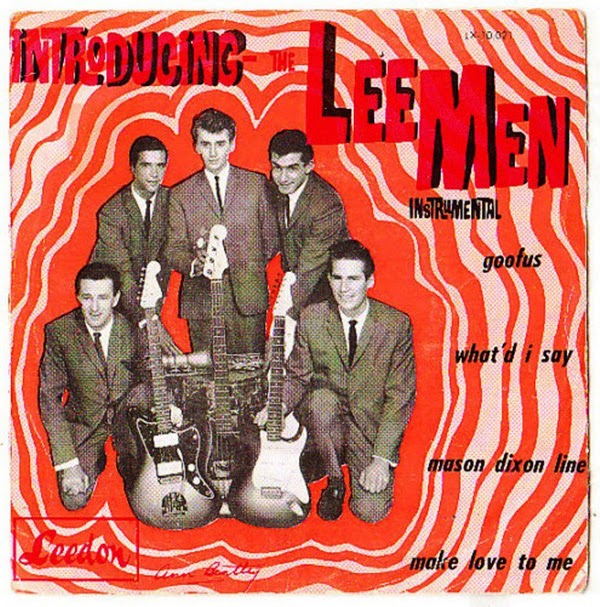
Leemen - Introducing The Leemen
What'd I Say/Make Love To Me/Goofus/Mason-Dixon Line
The Leemen are Lonnie Lee's backing band and have been there with him since the beginng and are still there today.
The Leemen had a hit in 1960 with Johnny Guitar it charted in most of Australia's capital cities #5 Sydney, #34 Melbourne, #18 Brisbane, #9 Adelaide and #16 Perth. They released a second single in 1961 "High Noon/Gumbo" plus two EP's "The Leeman With Voices" and "Introducing The Leemen" both released in 1961.
Delltones - Get A Little Dirt On Your Hands
Get A Little Dirt On Your Hands/A Happy Pair/ Land Of Beauty/Why
The Delltones are a popular Australian rock 'n roll band, originally formed in 1958. They started out as a vocal harmony group with members: Brian Perkins, Noel Widerberg, Ian 'Peewee' Wilson, and Warren Lucas. In 1962, their single "Get a Little Dirt on Your Hands" was in the top five on the Australian charts. Lead vocalist Noel Widerberg died in a motor vehicle accident. His position was later filled by Col Loughnan.
The Delltones have been entertaining Australian audiences for over five decades; their most successful recording years were in the 1960s. Ian 'Peewee' Wilson is the only current member from the original line-up. In the mid-1980s, he transformed the group from a vocal quartet to a five-piece vocal band. This, along with other stylistic changes, led to the band's resurgence and the chart topping, rock ‘n roll revival album, Bop Til Ya Drop. The band remains one of the most consistent live entertainers in Australia. It has arguably the longest performing and recording history for a vocal harmony band, with an original member, in Australia.
Get A Little Dirt On Your Hands #10 Sydney #17 Melbourne #5 Brisbane #10 Adelaide #14 Perth
Thursday, 21 May 2015
Tony Barber - 1967 - Looking For A Better Day
Looking For A Better Day/I Don't Want You Like That/Nobody/Is It Raining
Guitarist, singer, songwriter and author Tony Barber is one of the unsing heroes of the Beat Boom in Australia. Rock historian Dean Mittelhauser considered him "one of our most underrated performers from the Sixties" and felt that Tony had "played a bigger part in the success of Billy Thorpe & The Aztecs that has been generally credited".
Tony was one of the many music-crazy young migrants who arrived in Australia in the late 1950s and early 1960s, and he had played in a minor band called The Electrons before leaving the UK. Within weeks of his arrival in Australia in 1964 he met a cocky young singer called Billy Thorpe in Kings Cross and he was immediately drafted in as the fifth member of Billy's backing band, The Aztecs. Tony was already developing into a competent pop writer and he composed both sides of the Aztec's first single "Blue Day" / You don't love me", released on the Linda Lee label in April 1964.
Two days before The Aztecs' next recording session, Tony received a 'care package' from his brother in the UK that contained the Rolling Stones' first EP. Afer hearing The Stones' version of Lieber & Stoller's "Poison Ivy", Tthe Aztecs decided to record the song on their next single. It's now a matter of history that their version (widely regarded as being superior to The Stones') shot to #1, became one of the biggest Australian pop hits of the year, kept The Beatles out of the top spot in the Sydney charts in the very midst of their tour, and made Billy and The Aztecs into national stars. Tony featured on the next three Aztecs singles, "Mashed Potato" "Sick and Tired" and "Over The rainbow" -- all of which were major hits -- but in late 1965 Tony and the rest of The Aztecs quit en masse, mainly because of ongoing financial wrangles with manager John Harrigan.
After leaving The Aztecs, Tony and fellow Aztec Vince Maloney formed the shortlived Vince & Tony's Two, with John Shields on bass and Jimmy Thompson on drums. In late 1965 Tony was signed as a solo artist to the newly formed Everybody's label, which had been established by Clyde Packer's Consolidated Press. Tony's solo debut single (produced by Nat Kipner) was a thumping beat original called "Someday", which it was one of the first (and only) four singles issued on Everybody's. None of these singles -- including Tony's -- was unsuccessful on first release because of resistance from radio DJs who (not unreasonably) regarded the label as blatant cross-promotion for Packer's Everybody's magazine and refused to name it on air.
The label was hastily rebadged as Spin Records and Tony's single was re-issued in February 1966. This time it took off, becoming a major hit that peaked at #7 in Sydney and #11 in Melbourne. Tony released four more singles on Spin -- "Wait By The Water" (Apr. 1966), "Wondrous Place" (July '66), "Lookin' for a better day" (Jan. 1967) and "Bird's Eye View", which was written for a long-forgotten TV documentary. Tony was also granted the rare privilege of recording an entire LP, entitled Someday ... Now!, on which he was backed by labelmates Steve & The Board and The Bee Gees.
Although he was signed to Spin as a recording artist, Tony also worked with another independent label during this period, the Melbourne-based Phono Vox. He produced several singles by Phon Vox artists, including Denise Drysdale and The Bentbeaks, and he also wrote the A-side of Denise's single "Sunshine Shadow". In late 1967, after his Spin contract had ended, Tony released one single under his own name on Phono Vox, but this proved to be his swansong as a recording artist. During 1967 Tony married his girlfriend Sue Peck, a staffer with Go-Set magazine, and soon after he left the pop scene to concentrate on business ventures and raising a family. In the 1980s he reunited with his old friend Billy Thorpe in the successful 'Sunshine Friends' soft toy enterprise.
In 2002, after more than thirty years away from the limelight, Tony reunited with Billy and the original Aztecs for the historic Long Way To The Top concert tours. His experiences inspired him to write a memoir of the tour and his early days as a pop musician, entitled Long Way Til You Drop. Regrettably, there was opposition to the book from some of those involved in the LWTTT tour, fuelled by pre-publication media hype that suggested it would be a tell-all exposé. In the event, Tony's book proved to be an entertaining, witty and affectionate account of an important chapter in Australian rock history.
Friday, 15 May 2015
Red Onion Jazz Band - At The 1963 Jazz Convention
Since My Best Girl Turned Me Down/Barnacle Bill/Perdido Street Blues/Tight Like That
The Red Onion Jazz Band was formed around 1960, as the Gin Bottle Jazz Band by Allan Browne, who was taking lessons from Melbourne University Jazz Band's drummer, Norm Hodges, and Brett Iggulden who was taking trumpet lessons from Ade Monsbourgh, then one of Australia's leading jazzmen. The original lineup, drawn largely from the Beaumaris, Sandringham and Brighton suburbs of Melbourne, consisted of Allan Browne, drums; Brett Iggulden, trumpet; Kim Lynch, tea-chest bass; Bill Howard trombone; Felix Blatt, banjo, and John Pike, piano, while Brett’s sister Sally (a.k.a. ‘Sweet Sal’, who later married Browne and became a clothes designer) was an occasional addition on washboard. John Funsten, another pupil of Ade Monsbourgh, was added on clarinet. They played New Orleans inspired traditional jazz and infused it with their own vitality, their flair for presentation and promotion and zany sense of humour.
Jazz standards were the material for their first job at St Michael & All Angels Anglican Church hall dance in Beaumaris, and by about April 1961, they were given a brief spot at the Melbourne Jazz Club; their first introduction into the Melbourne jazz scene and in June Corrine Kirby included them on her ABC T.V. programme Let's Make a Date for which, at the insistence of Channel 2 executives a name change from their original Gin Bottle Jazz Band to the more respectable Red Onion Jazz Band was made, the title chosen in honour of an early Louis Armstrong recording group. They opened then at the 'Oxford' Jazz Club, where they continued for six months, with Fred Charles on clarinet.
In November, 1961, Geoff Thomas took over from Felix Blatt as banjoist and the band started the Red Onion Jazz Club in Brighton. They also played at the Downbeat Jazz Concert in 1962 before Fred Charles and Geoff Thomas left the band in October and were replaced by Gerry Humphries (born Brian Anton Humphrys, 1941, in Battersea, England) and Rainer Breit. After securing gigs at the Ormond R.S.L. Hall and Beaumaris Yacht Club, they joined the 17th Jazz Convention in Sydney in December 1962, where their long hair, formal wear, violins and mad vocals caused a stir. Returning to Melbourne they played Friday nights at the 'Newport' Jazz Club at the Edithvale Life saving Club and on Saturday nights at their own venue ‘The Onion Patch' in Oakleigh. In early 1963, the group released their first 7” EP, An Impromptu Recital by the Amazing and Entertaining Red Onion Jazz Band on the tiny EAST (Elwood Audio Services Transcriptions) recording label, and it received conspicuous airplay on radio station 3XYs Jazz As You Like It program. John Pike left in March and for 11 months the band played without a pianist, but had a busy year of concerts that included Moomba, Myer Music Bowl, a 3-day tour of Tasmania including radio, T.V. and dance engagements in Hobart, as well as the 18th Australian Jazz Convention. The Red Onion Jazz Band at the 1963 Jazz Convention EP (their second recording) contains two vocal tracks; the bawdy sea-shanty "Barnacle Bill", and a version of Tommy Dorsey's "It’s Tight Like That". Gerry Humphrys left the band for four months in June, 1963, and Jerry Salt, Derek Miller or Eddie Robbins replaced his clarinet, while Brett Iggulden took up alto sax for special numbers. Venues then included the 'Driftwood' Club and the 'Downbeat' Jazz Club where in February 17 year-old pianist Ian Clyne first sat in and thereafter became a regular member.
In July, 1964, The Red Onions signed with W&G Records who put out a well-received EP entitled The Red Onions At Home and they transferred from the 'Onion Patch' to the popular 'Campus' Club. They appeared again on TV for GTV9 and ATV0, most importantly on Graham Kennedy’s influential In Melbourne Tonight. In November the band opened at ‘Opus' discotheque in South Yarra where it was estimated that more than 2,000 attended the first night. The entire band also featured at the 19th Jazz Convention in Newcastle.
Thanks to Sunshine for this one.
Monday, 11 May 2015
Johnny O'Keefe - 1964 - A Girl Needs To Love
A Girl Needs To Love & Be Loved/Moon River/Send Me The Pillow/Lollipops & Roses
Born in Sydney on 19 January 1935, Johnny O'Keefe became the undisputed King of Australian rock and roll. There was little or no rock music scene in Australia, and certainly no Australian rock recordings, prior to 1957, when Bill Haley toured the country. A local band, the Dee Jays with vocalist Johnny O'Keefe, was chosen as the supporting act. Johnny O'Keefe had been performing in talent shows, mainly doing impersonations of Johnny Ray singing songs such as Crying and The Little White Cloud that Cried (complete with prop glasses filled with water to make artificial tears). His performance supporting Bill Haley led to a contract with Festival Records.
At his first recording session on a Saturday afternoon in July 1957, Johnny recorded Bill Haley's Billy Goat and I'm Still Alive. (The recording had to be on a Saturday afternoon because Johnny was working in his father's furniture shop in the morning and during the week - and, of course, you couldn't work on a Sunday in the fifties.) Reluctant radio stations gave very little airplay to Johnny's first record but, by the time of his next recording, Wild One, early in 1958, there was sufficient demand from Johnny O'Keefe Fan Clubs throughout the country to make it a hit. Many of these Fan Clubs had arisen out of performances which Johnny gave at Police and Citizens Boys Clubs.
A series of hit records and performances on Lee Gordon's "Big Shows" supporting overseas artists (who often were greeted with chants of "We want Johnny") led to Johnny being given his own national TV show, Six O'Clock Rock, in 1959. The TV show ran until 1962 when Johnny left to tour America (with limited success).
Overwork led to Johnny being instructed by his doctors to take a rest, but he was soon back on television with another show Sing! Sing! Sing! and recording another string of hit records. The pattern of dynamic performance leading to overwork, depression and breakdown was repeated for the next ten years. This, together with a serious car smash which required several operations to reconstruct his face, culminated in Johnny's death from a heart attack in October 1978.
During his career, J O'K had five number one records and ten other top ten hits. The recording for which he is best remembered, Shout!, was recorded and released as a single twice (in 1959 and in 1964) but never achieved better than number 11. Relatives of him have also become celebrities, such as his nephew Andrew O'Keefe. His daughter has a cameo in the TV movie bio about his life, Shout! The Story of Johnny O'Keefe (1985).
Tyrn Around - 1986 - Colour Your Mind
Carroll By Candlelight/Francis/Colour Your Mind/Suicidal Flowers
Formed in 1985 in Melbourne, Australia, Tyrnaround were a great band who specialised in 60s psych pop/rock, influenced by Syd Barrett, The Seeds, The Beatles at their most lysergic, garage punk and classic psych. They released a handful of cassettes, EPs and one album before disbanding due to the death of their lead singer in 1999.
Wednesday, 29 April 2015
Dig Richards - 1960 - At The Melbourne Town Hall
Bony Moronie/Lotta Lovin'/My Babe/Please Don't Tease
Digby George Richards (1940-1983), singer and composer, was born on 12 September 1940 at Dunedoo, New South Wales, elder child of New South Wales-born parents Gordon Forrest Richards, policeman, and his wife Mona, née Dennis. Dig attended Narooma Central and Moruya High schools. After completing the Leaving certificate in 1957 he worked at Waltons-Sears Ltd in Sydney.
His family and American rock’n’roll music were major influences on Dig. His brother Doug learned melody lines on their father’s guitar and started writing songs. Dig abandoned his retail traineeship for music, after becoming the vocalist for the band ‘The R-Jays’, which sought a recording contract. Ken Taylor of Festival Records auditioned the band in 1959 and, largely on the strength of Doug’s song I Wanna Love You, signed them. They became the third local artists, following Johnny O’Keefe and Col Joye, to gain a contract with Festival Records. The song entered radio 2UE’s Top 40 on 25 July 1959, and spent seventeen weeks on the charts, reaching number eight. Between his first hit and May 1960, Dig recorded more songs with ‘The R-Jays’, three of which—I’m Through, (Real Gone) Annie Laurie and Comin’ Down with Love—entered the charts, but did not have the success of their first record.
A handsome man with a good stage personality, Dig Richards was a popular performer who supported American singers including Ricky Nelson and Crash Craddock. Television shows such as ‘Bandstand’, from 1958, and O’Keefe’s ‘Six O’Clock Rock’, from 1959, extended his audience and popularity beyond dances and live performances. From August 1959 ‘The R-Jays’ were the studio band for ‘Teen Time’ on Channel 7.
Richards’ career was threatened as a result of injuries he sustained in a car accident in October 1959. A couple of years later he and ‘The R-Jays’ parted amicably and he began to write his own material. While he kept his early fans, he wanted to broaden his appeal. He took voice and guitar lessons and developed a new image. A comeback single in 1962, Raincoat in the River, defined his change from rock’n’roller to a slightly folky, country singer. On 10 July 1964 at the Church of St John the Baptist, Milsons Point, he married with Anglican rites Susan (Suzanne) Margaret Clark, a telephonist. That year he hosted the ‘Ampol Stamp Quiz’, a television show for children. Often performing in clubs, he sought new markets in South-East Asia, touring there—including Vietnam—in the late 1960s.
In 1970 Dig went to England, returning as Digby, complete with beard and longer hair. He recorded Harlequin, an album of his songs, which had several hits including A Little Piece of Peace and People Call Me Country. Recording earlier with CBS Records, he switched to the Radio Corporation of America and RCA Records of Australia Pty Ltd. In 1973 he recorded in Los Angeles with top session-musicians, who were attracted not only by the quality of his songs but also by his Australian accent. This album, Digby Richards, also produced several hits.
Diagnosed with pancreatic cancer in April 1982, Richards died on 17 February 1983 at St Leonards, Sydney, and was cremated. His wife and their son and daughter survived him.
Thursday, 9 April 2015
Johnny O'Keefe - JOK
Be Careful Of Stones That You Throw/My Heart Belongs To Only You/The Steady Game/It's Too Late
A national icon. An inspiration to Australians everywhere. The man who single-handedly defined Australian Rock and Roll. Johnny O'Keefe can say yes to all those and more. Johnny O'Keefe single-handedly did more to influence Australian pop-culture than any other national figure. Born on the 19th of January, 1935, Johnny was the younger of two boys. Older brother Barry (b. 1933) Became a prominent Judge and lawyer in Australia. Born only eleven days after Elvis Presley, Johnny O'Keefe was often called 'Australia's answer to Elvis and Jerry Lee Lewis'. He was all this and more. Right from the get go this raw, precocious, kinetic, talented, young, self-promoting rocker from Sydney rocked the ultra-conservative world of Robert Menzies' Australia in the 1950's, with his gyrating, rebel-yelling performances out the front of his band, The Dee-Jays. Australia, stuck in the conservative 1950's, had never seen anything like this leopard skin suited, ripple soled rock and roll maniac who was 'morally corrupting their children'. And he was Australia's. Someone to call their own. Johnny O'Keefe was Australian, and proud of it. Johnny O'Keefe spoke to the very heart and soul of a generation of Australian teenagers who were screaming out for an identity, and he forever changed the way Australian's view themselves, because he was the first, the very first, person who showed Australia that they could rock just as hard as an international singer. And that is exactly what Johnny O'Keefe did. O'Keefe's success was by no means confined to Australia. In the late 50s he toured through the U.S. where he appeared on 'The Ed Sullivan Show', and became a local legend with his hilarious boomerang throwing exploits as 'the boomerang kid' in New York's Central Park. Johnny O'Keefe is hard to comprehend in today's celebrity for celebrity's sake world. He was the real deal. Johnny O'Keefe was the truly unique Australian.
Sunday, 5 April 2015
Dave Allenby - She Works In A Woman's Way
She Works In A Woman's Way//Midnight Special/Let's Get A Little Sentimental/Bygone Days
Dave Allenby was a popular Sydney TV and club performer of the late '60s /early '70s who made several interesting crossovers into the pop arena. In April-May 1970 he supported The Beach Boys on their Australasian tour, performing on all the New Zealand and Australian shows except for the band's concluding 10-day residency at Sydney's Chevron Hotel.
Allenby also had a brief burst of pop success in 1971 when he released a single on the independent Chart label. Backed by popular Sydney band Autumn, he recorded the catchy single "She Works In A Woman's Way", backed by a raucous version of the Leadbelly standard "Midnight Special", arranged by Barrie McAskill, lead singer of Levi Smith's Clefs..
The A-side, originally recorded by Edison Lighthouse, was penned by UK songwriters Barry Mason and Tony Macaulay, who also wrote "Melanie Makes Me Smile" (recorded by The Strangers).
The single was quite successful in Sydney #5, where Allenby and Autumn were both popular, and it also managed to briefly scrape into the bottom spot on the national Top 40 in February 1971. The two tracks were included on Autumn's debut album Song For Raymondo, and "Midnight Special" was also included on the Chart EP The Best of Whisky A-Go-Go, which comprised two tracks by Autumn ("Midnight Special" and "Day Tripper") and two tracks by Levi Smith's Clefs. This EP is highly sought after and now fetches around $200 on the collector's market.
Normie Rowe - Going Home
Going Home/I Don't Care/If It Don't Work Out/The Night
Norman John "Normie" Rowe AM (born 1 February 1947) was a solo performer of Australian pop music in the 1960s, and an actor of theatre and soap opera for which he remains best known as Doug Morrell in (Sons and Daughters). As a singer he was credited for his bright and edgy tenor voice and dynamic stage presence. Many of Rowe's most successful recordings were produced by Nat Kipner and later by Pat Aulton, house producers for the Sunshine Records label. Backed by his band, The Playboys, Rowe released a string of Australian pop hits on the Sunshine Records label that kept him at the top of the Australian charts and made him the most popular solo performer of the mid-1960s. Rowe's double-sided hit "Que Sera Sera" / "Shakin' All Over" was one of the most successful Australian singles of the 1960s.
Between 1965 and 1967 Rowe was Australia's most popular male star but his career was cut short when he was drafted for compulsory military service (called National Service in Australia) in late 1967. His subsequent tour of duty in Vietnam effectively ended his pop career and he was never able to recapture the success he enjoyed at his peak
New Dream - Soft Delights
Soft Delights/You Got Me Singing/Candy Love/Do You Think You Can Make Me Happy
The Dream formed in 1967 when singer Alex Opitz and keyboard player Jenny Johnson, both from The Changing Times, joined forces with members of another Melbourne discotheque band, The Final Four. In January 1968 they appeared as a support on the infamous Who-Small Faces "Big Show" tour, and in June Peter Nicoll left the group, to be replaced by Brian Holloway. Holloway left later in the year to join the remaining members of Somebody's Image, which became The Image after the departure of lead singer Russell Morris, and he subsequently played in Ronnie Charles' shortlived supergroup Captain Australia & The Honky Tonk.
The Dream did not make any known commercial recordings. In April 1969 the group was relaunched as The New Dream, and their style changed to exploit the current "bubblegum pop" trend; Glenn A Baker has written that their agency was grooming the band to take over from Zoot. They signed with Festival and issued their first two singles during the year, "Yours Until Tomorrow" (April) and Catching Up On Fun" (July), which made the Melbourne charts.
Their first national success came with their third single, "Groupie", one of a string of successful formula bubblegum songs written by Buzz Cason, the American who also penned "Hayride" (the hit debut for The Flying Circus) and "Everlasting Love", which was also a big hit for The Town Criers. "Groupie" became a national hit, reaching #28 in March 1970, but the time the single came out the lineup had changed to Kadell, Johnson, John Bois (bass) and Peter Reed (drums).
Regular dance circuit bookings and TV appearances on Happenning '70 helped the band to build up popularity with teen audiences, and their next three singles all made the charts. "Soft Delights" (May 1971) only just missed out on a Top 20 placing, and although "Candy Love" (Sep. 1971) only scraped into the lower reaches of the Top 100, "Turned 21" (March 1972) fared much better, reaching #31. In January 1972 John Bois left to join Country Radio and he was replaced by Graham Jones (also ex Iguana, Captain Australia & The Honky Tonk).
This new lineup recorded their only LP and their last two singles, a cover of T-Rex's "Ride A White Swan" (Dec. 1972) and "Girl I'm Gonna Get You" (Feb. 1973). Their self-titled LP, produced by Brian Cadd, featured what Ian McFarlane describes as "...a gloriously campy mix of the band's bubblegum hits, easy listening pop fluff replete with sweet harmonies and schmaltz strings, plus a cover of joni Mitchell's 'Cheslea Morning' ...".
The group broke up at the end of 1972; with Kadell embarked on a solo career, and Peter Reed joined Gary Young's Hot Dog (he later played with Pantha and Bandicoot, the group that featured Mick Fettes (Madder Lake) and Shane Bourne). Kadell and Johnson revived the New Dream name for two singles released during 1974. The first, "I Can't Stop Dancing (In The Dark)" (July) was written by Andy Fairweather-Low and produced by Steve Groves (ex Tin Tin); the second the oddly-titled "Schlick Schlak Boom Boom" was produced by Buddy England. Neither single made any impression, and the group faded from view.
Rondells - The Rondells
She'll Never Know/Carol Ann/I'll Be Gone/Whatcha Gonna Do
The Rhondells were one of the more notable bands on the Australian music scene of the mid-1960's, if only for the fact that three of their members went on to serious careers in music. They first showed up in an important way on record backing Bobby & Laurie (another down-under act) on "I Belong To You, " before getting signed themselves to the Go!! label in 1965, for which they cut a pair of singles and an EP. Bernie O'Brien was the leader and did some songwriting when they weren't covering rock 'n roll standards, and the constantly shifting line-up, at one point, included Wayne Duncan (bass) and Gary Young (drums) who, at the turn of the decade, became the rhythm section for Daddy Cool and, later still, Jo Jo Zep & the Falcons; and Gil Matthews, later a member of Max Hamilton & the Impacts, Levi Smith Clefs, and The Aztecs, among other bands. One early line-up, in addition to O'Brien, included Denis Tucker (bass), John Sullivan (rhythm guitar), and Dennis Collins (drums). In any incarnation, they were a hard-rocking outfit, surprisingly close in spirit to the Kinks.
Saturday, 4 April 2015
Penny Rockets - Johnny B. Goode
Johnny B. Goode/The Storm Is Over/What Am I Living For/Loving Woman
Formed 1958 Adelaide, South Australia known as "The Rock and Roll Kings" of South Australia.One of South Australia’s first true recognized rock groups to make inroads at that time.Coming out of the Big Band era they could probably see how the scene would change, and that it did.
The Penny Rockets were stars in there own right and even though they only had two record releases for those days it was something very special and in actual fact, they were special.The group would often include’ The Four Tones’. The Penny Rockets spanned a career of over 10 years playing at all major venues including ’The Princeton Club’ dances and Radio.
Members included
RAY O’CONNER - saxophonist, lead vocalist
RON CARSON - double bass
BRIAN PENGLASE - lead vocalist
KNOBBY DOUG CLARK - saxophonist/flute
BRIAN DAVIDGE - bass
VONNIE JAY - vocalist
LEE SELLARS -vocalist
DOUG TOLL - guitar - Leader
GRAHAM SHRADDER - piano
JOHN 'SLICK’ OSBORN - drums
FRANK NEWLAND - guitar Brother of Ron Carson)
DAVE FRANK - bass
ALLEN HEWITT - piano
PETER HARVEY -bass
REX BLAIR - Drums replacing John "Slick" Osborn.
The band backed "The Four Tones" which included some of the above such as Lee Sellars,Rhett Walker, Ray O'Conner.
The band through the years had many line up changes in the group but kept on going, now we have lost most of the members but the band will always be remembered as the very first to enter the arena of South Australian popular rock music.
Friday, 3 April 2015
De Kroo Brothers - Scarlet
(And Her Name Is) Scarlet/All Right Be That Way/Tears Of Pity/It Never Came True
In March 1960 Columbia released their debut single On The Job Too Long and then much to their surprise, Columbia released their second Loveland six days later. With little airplay both records flopped. By the end of 1960 they had appeared on the Six O'Clock Rock, Bandstand, and Teen Time. In March 1961, Columbia issued their third and final single, but once again it failed to make an impression on the charts. When Columbia didn't take up the option on their contract they moved to Festival Records. In October they played on the support bill for the Cliff Richard and the Shadows Show tour of Australia and New Zealand. In September 1963 they finally scored their first Top 10 hit with their fourth Festival single (And Her Name Was) Scarlet. Festival released three more singles over the next year or so without much success. They continued to perform on the club circuit until 1972 when they decided to call it quits. Doug opened up a music teaching business in Sydney and continued playing with various rockabilly groups while Les bought a farm in Dubbo where he is a weekday morning radio announcer with 2DW.
Sunday, 15 March 2015
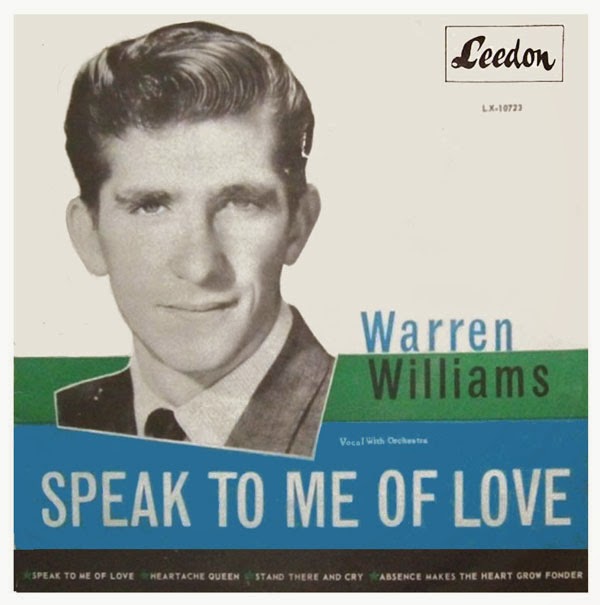
Warren Williams - Speak To Me Of Love
Speak To Me Of Love/Heartache Queen/Stand There And Cry/Absence Makes The Heart Grow Fonder
Forming one of Australia's first rock & roll bands in the tradition of Bill Haley and His Comets, former child soprano Warren Williams formed Warren Williams and the Squares in January 1958: by April they were playing to 600 people each Friday night at the Mascot Masonic Hall.
They made their TV debut in July 1959 on Six O'Clock Rock, a popular TV show hosted by Johnny O'Keefe, and soon became TV regulars on Bandstand and Teen Time. Williams released his debut single, "My Teenage Love," in December 1959 followed by "Kath-a-Leen" in April 1960, but by the end of the year had left the Squares. He released the single "My Little Girl" and was voted the sixth most popular artist on Six O'Clock Rock.
In 1961, Williams signed with the Leedon label and released several singles. A prolific songwriter, he formed his own publishing company Williams-Conde Music Pty Ltd with Franz Conde. In March 1964, Williams joined the Courtmen, who backed him on his track "It's Party Time" (later recorded in French by Petula Clark). By now, Williams' popularity had begun to wane with the rise of pop. As Beatlemania swept Australia, Williams took refuge performing in clubs and cabaret shows before resurfacing in the '70s and '80s on the nostalgia circuit. He released two singles, "Jimmy Brown the News Boy" (1978) and "I Was There" (1982), before forming the Williams Family Show with his three sons.
P.S. I've accidently numbered tracks 1 and 4 in reverse track names are correct just out of order.
1
Subscribe to:
Posts (Atom)